You’ve hired someone to fix your website and it worked. You’re now showing up on Google, getting traffic. The numbers are encouraging.
But your calendar isn’t filling up, you’re not making more sales from your website. People click and visit, but they’re not becoming clients. And now you’re wondering if you wasted your time, your money, or both. Because being visible doesn’t necessarily mean you’ll get more clients.
In this article we’ll see how to change that so you know what your website needs to sell for you:
- Why Google traffic doesn’t always mean client inquiries or sales
- What your visitors are actually doing on your site (and why they leave)
- The gap between being found and being hired
- How to turn your website traffic into sales
- Your action plan is traffic isn’t converting into sales
TL;DR
Getting found on Google is only half the job. If your website is visible but doesn’t convert visitors into clients, the problem isn’t your visibility. It’s your messaging, user experience, and trust-building elements. Fix those and your traffic starts turning into real clients.
Why Google traffic doesn’t always mean client inquiries or sales
You can be on page one, have hundreds of people visiting your site every month, and you can still be sitting there, wondering why your website isn’t “working”.
Because here’s what most people don’t realize: traffic is one thing, not all traffic is the same.
Some people are doing research for a school project, some are checking you out with no intention of hiring anyone just yet. And some are looking for free information so they can DIY the thing you charge for.
Google doesn’t filter for intent, it sends people who typed in the words and matches your website with their search.
So if your website is showing up for “how to groom a poodle at home,” you’re going to get a lot of DIYers.
But if your business shows up for “best poodle groomer near me,” you’re going to get people ready to book.
Same topic, but completely different audiences with different search intents.
This is why you can have traffic and still hear crickets.
You’re either visible to:
- the wrong people,
- the right people at the wrong time
- to people who just want to learn, not hire.
- to the right people exactly when they search for your expertise and want to hire now.
Visibility is step one, but it’s not the end goal.

What your visitors are actually doing on your site (and why they leave)
Here’s a fun exercise: pull up your Google Analytics, look at your bounce rate and the average time spent on a page.
If people are landing on your site and leaving in under 30 seconds, that’s not a traffic problem, that’s a messaging problem.
They found you, they clicked and landed on your page, then they left because nothing on your site answered the question they actually had.
Here are a few examples of what could be happening:
- your homepage is maybe full of pretty photos but vague statements like “We help you thrive” or “Empowering your journey.”
- “services” page lists what you do but not why it matters.
- Your About page is a resume instead of a story that builds trust. Your visitor doesn’t care that you have 15 years of experience or that you’re passionate. They care whether you can understand what they’re going through and will help them solve their problem.
If your site doesn’t immediately make your visitors feel seen, understood, and confident that you’re the right choice, they’re gone. And they’re booking with someone else whose site did.
Your website copy needs to speak to them, about them
Here’s what most people do wrong:
- They write for Google instead of humans:
- stuff keywords into sentences that sound robotic
- bury the important stuff under jargon and fluff
- assume people will read every word when most people skim.
- Or they write for themselves:
- talk about their process,
- their credentials,
- their philosophy.
All of that matters, but not first. First, you have to prove you understand their problem better than they do. Then they’ll care about your credentials.
Your website has about three seconds to answer these questions or you’ll lose traffic AND sales:
Am I in the right place? Do you understand my problem? Can you fix it? What do I need to do next?
If the answer to any of those is unclear, they leave.

The gap between being found and being hired
So let’s say you’ve fixed the messaging. Your site is now clear, your copy speaks to the right people. They land on your homepage and think, “Yes, this is exactly what I need.”
Great. Now what?
This is where most websites fall apart and traffic doesn’t convert into sales.
Because even if someone is interested, they’re not going to hire you on the spot. They’re going to click around, your About page, check out your services. In other words, they’re going to look for proof that you’re legit.
And if any part of that journey feels confusing, generic, or unconvincing, they leave.
Here’s what I see all the time:
Someone gets found for the perfect keyword, their homepage is solid, but their services page is a list of bullet points with no context, their About page reads like a LinkedIn bio, they don’t have testimonials from past clients, or their contact page just says “Get in touch!” with no reason why someone should.
The gap between being found and turning this traffic into clients is trust.
People don’t hire you simply because you show up on Google, but you because they believe you can help them. And belief comes from proof.
Proof looks like:
- Case studies that show real results, not vague wins.
- Testimonials that explain the before and after, not just “Great to work with!”
- An About page that tells a story, not a timeline.
- A services page that explains why your approach works, not just what you do.
- A contact page that makes the next step feel easy and low-risk.
If any of those pieces are missing or weak, you’re leaving money on the table.
I once worked with a therapist whose website was 3 years old but not doing much for him.
We looked at his site together: not much text for Google to really understand what he was really doing or whom to show his website to, no context, no reason to choose him over the five other therapists who also help with anxiety and trauma.
I rewrote his website sections to explain what his method actually does, who it’s for, and what results his clients see.
We added a section called “What working with me looks like” so people could picture the process. I build a new page to talk about his book and actually sell it (to complement his work and give more context).
I’m also updating his testimonial page monthly, not only for his prospect to see the type of results his clients are getting, but to also bring more fresh content to Google.
Two months after this optimization and copy tweaks, his website started bringing him clients who’d find him on Google… after 3 years of catching digital dust, his website finally started working for him. He’s now also selling his book on auto-pilot.
That’s the gap that gets bridged, that’s when traffic converts into clients and sales.
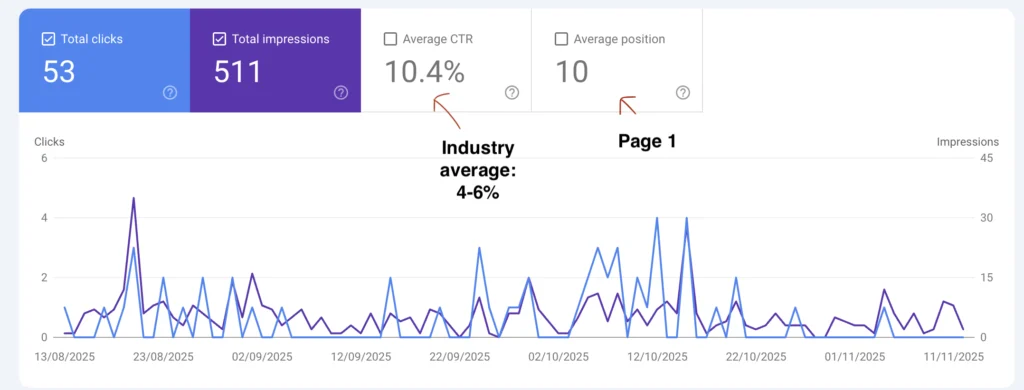
As you can see below, he’s getting really specific traffic, he’s been very specific on his target audience, his copy attracts the right people and repels those who aren’t a good fit. His click-through rate is at 10,4% (the ratio between those who see his website and actually click to visit it) is above the industry average (4-6%).
How to turn your website traffic into sales
Your website should work for you, bring in leads while you sleep, answer questions, build trust, and get people to book without you working harder on your marketing.
But most websites aren’t doing that.
Here’s how to fix that.
First, map out the “buyer journey”.
Not your sales process, but the journey your ideal client is actually on. You do this by answering these questions:
- What problem are they dealing with right now?
- What have they already tried?
- What are they afraid of?
- What do they need to believe before they’ll hire you?
Your website needs to meet visitors where they are and walk them to the next step.
If someone lands on your site and they’re just starting to realize they have a problem, they need education. Give them a blog post or a resource that explains what’s going on and why it matters.
If they know they have a problem and they’re researching solutions, they need options. Show them what’s possible, explain your approach, give them proof it works.
If they’re ready to hire someone and they’re deciding between you and two other people, they need differentiation. Tell them why you’re different, show them your process, make it easy to say yes.
Most websites try to do all of this on the homepage, that’s too much. Instead, guide people, use clear calls to action, link to the right next step based on where they are.
Second, write for people, not robots.
Yes, you need keywords, yes, SEO matters. But if your copy sounds like it was written by a machine for a machine, people won’t trust you.
Use the words your clients actually use. If they say “I’m overwhelmed,” don’t say “experiencing burnout.” If they say “my website isn’t working,” don’t say “optimize your digital performance.”
Talk like a human, write like you’re explaining this to a friend over coffee.
Third, make your website do the selling for you.
- Your homepage should explain what you do, who it’s for, and what happens next.
- Each service page should answer “Why this? Why you? Why now?”
- Your “About me” page should build trust and connection, not just list facts.
- Your contact page should remove friction and make it easy to take action.
If you can nail those four pages, you’ll convert more of the traffic you’re already getting into sales.
Your action plan is traffic isn’t converting into sales
If you’re in this situation right now, here’s your action plan.
Step one: check your Google Search Console.
Look at what keywords you’re actually showing up for. Are they the right ones? Are they bringing in people who are ready to hire, or people who are just browsing?
If you’re showing up for the wrong keywords, you need to adjust your content. Write for buyer intent, not just search volume.
Step two: audit your messaging.
Read your homepage out loud. Does it sound like you? Does it speak to a real problem and make someone think, “This person gets me”?
If not, rewrite it. Strip out the jargon, get specific, talk about the real struggle your clients are facing and how you fix it.
Step three: check your calls to action (your buttons).
What are you asking people to do? Is it clear and easy? Is it a no-brainer step for where they are in their journey?
If your only button is “Book a call,” but most of your traffic is from people who aren’t ready yet, add a softer option, like a free guide, a quiz, a quick email course. Something that keeps them engaged until they’re ready to work with you.
Step four: add proof.
If you don’t have testimonials, get them, if you don’t have case studies, create them. If you don’t have an About page that builds trust, write one, I have a free guide that will help you.
People need to believe you before they’ll buy from you. Give them reasons to believe.
Step five: track what’s working. with Google Analytics and Google Search Console.
See where people are dropping off, which pages are getting more views and bringing clients and which ones aren’t. Use that data to make decisions, not guesses.
And if all of this feels overwhelming, that’s normal. Most service providers are good at what they do. They’re not copywriters or SEO strategists. They’re experts in their field, and that’s where their time should go.
That’s why I built Sold Out SEO. It’s a hybrid course with support that teaches you how to build a long-term marketing strategy so your website gets seen AND actually brings in clients without you posting on social media every day.
You learn how to choose the right keywords, write copy that sells, and set up a system that works while you’re doing literally anything else.
If you’re tired of getting traffic that goes nowhere, this is how you fix it.
FAQ – How to turn traffic into sales
How long does it take for SEO to bring in clients?
SEO is not instant. It takes time for Google to index your pages, and send you traffic. Most people see results start seeing a slight increase in 20 days to 4 weeks, with significant improvement from month 3 onward if they’re doing it right. But once it kicks in, it keeps working. Unlike social media, where you have to keep posting to stay visible, SEO compounds. The content you write today can bring in clients two years from now.
Can I show up on Google if I’m in a competitive industry?
Yes, but you have to be strategic. You’re not going to outrank the big players for broad keywords like “lawyer” or “therapist.” But you can rank for specific, long-tail keywords that your ideal clients are actually searching for. Think “family lawyer for high-conflict custody cases in (city)” instead of just “family lawyer.” The more specific you are, the easier it is to rank and the better the traffic you’ll get.
What if I’m getting traffic but the wrong kind of people?
That’s a keyword problem. You’re appearing for terms that attract browsers, not buyers. Go back to your keyword research and focus on search intent. Look for phrases that indicate someone is ready to hire, not just learn. And make sure your content matches that intent. If you’re writing educational content, you’ll attract students. If you’re writing for buyers, you’ll attract clients.
Do I need to blog to get clients from Google?
Not necessarily. You can get your service pages and your homepage seen without a blog. But blogging does help because it gives you more chances to be found for different keywords and it builds authority over time. The key is to write content that actually serves your business. Don’t blog just to blog, but to answer the questions your ideal clients are asking, and make sure every post has a clear next step that leads them closer to hiring you.
What’s the difference between getting traffic and getting prospects?
Traffic is just people showing up. Prospects are people who are interested and ready to take action and become clients. You can have thousands of visitors and zero prospects if your site doesn’t guide them to the next step. That’s why conversion matters just as much as visibility, you need both.
Ready to turn your website into a client-getting machine?
If you’re tired of watching your traffic numbers go up while your bookings stay flat, it’s time to fix the gap.
Sold Out SEO is a 6-month hybrid program with support that teaches you how to build a Google-first marketing system that brings in clients consistently, without relying on social media.
Over 6 months, you’ll follow a clear, step-by-step system: keyword research that attracts buyers, website copy that sells, and a long-term visibility strategy you can maintain in 5 hours a month. You get weekly calls, concrete action steps, copy reviews, and community support, so you’re never stuck wondering what to do next.
No more posting just to stay visible. You’ll build a marketing system that gets you found by the right people and turns traffic into clients, designed around your business, your schedule, and your personality. (You won’t have to dance on Reels if that’s not your vibe, it’s not mine either!).
See you inside,
Morgane

Other articles you might want to read next: