A pet owner searches “vet near me for limping dog” at 9 PM. A random blog post written by another vet located in another state shows up. Your website doesn’t, and it’s a missed opportunity to connect with a potential client and build trust.
Running a vet clinic already takes most of your time and energy. Between patients, staff and emergencies, marketing usually ends up last on the list.
Social media feels noisy, inconsistent, and time-consuming, you’re naturally not really keen on posting (can’t blame you, I’m not either!).
Your website should be helping you with your marketing, even more so with a well-written blog.
The goal is not to post forever (unless you do want to), but to make your veterinary clinic easier to find when pet owners are actively looking for care. Let’s see how blogging can quietly bring new clients to your clinic, without adding more to your plate.
What this article covers:
- Why relying only on word of mouth and social media limits your vet clinic’s growth
- How a blog helps your clinic get found, trusted, and recommended
- Why vet blogs often fail to bring clients and how to make yours work for you long-term
- Get new clients with blogs that actually get read by pet owners
- FAQ
TL;DR
A blog helps your vet clinic show up on Google and AI search results when pet owners are actively looking for care. It builds trust before first contact, positions you as an authority with clients and peers, and keeps working long after you hit publish. One solid post per month for a year beats daily social media posting and gives you long-term results without the constant hustle.
Why relying only on word of mouth and social media limits your vet clinic’s growth
Word of mouth is powerful, but it’s slow and unpredictable. Social media can help visibility, but require constant effort, given that posts disappear quickly. Neither guarantees that your clinic shows up when someone searches for help with a worried pet.
When a pet owner types a question into Google, speaks to their phone, or asks an AI tool for help and a trusted source of info, they’re usually ready to act. If your clinic doesn’t appear at that moment, someone else does.
A blog fills that gap by helping your website show up when intent is high and stress is real.
How a blog helps your clinic get found, trusted, and recommended
A blog does more than bring traffic. It explains your expertise before someone ever calls or books an appointment.
Here’s what optimized blog articles do for you:
Build trust with pet owners:
Blog articles that answer common concerns in clear language build trust early and reassure them that they’re in good hands.
A post titled “What to do if your dog ate chocolate” could bring 50+ worried pet owners to your site every month and turn half of them into booked appointments.
Get your clinic found and trusted by search engines
For search engines and AI tools, blog content gives more context to your veterinary website.
It helps search engines (Google, Bing, DuckDuckGo, etc.), AI-driven search (ChatGPT, Claude AI…), and voice assistants (Siri, Alexa…) understand what your clinic does exactly, who it serves, and when to recommend you.
Be seen as a reference by your peers
Technical or in-depth articles can position you as a reference among your peers. Writing about complex cases, protocols, or emerging topics shows leadership and strengthens your professional visibility.
This kind of content supports referrals, partnerships, and long-term credibility, not just bookings. It can also bring you opportunities to write for magazines, be recommended for certain research projects, etc.
This is the kind of work I do for vet clinics who want their website to bring in clients while they focus on patients. I handle everything for you: the strategy, the topics, the structure, the writing.
We make sure that the topics align with your expertise and your vision, and I make sure to ask you for your own opinion. Your voice and your own ideas will transpire. Think of me as a ghostwriter who handles the tech part too.

Why vet blogs often fail to bring clients and how to make yours work for you long-term
Few vet clinics have a blog and most clinic blogs fail for simple reasons:
- Blog articles are written without strategy and (local) SEO, so no one finds them.
- They’re often too technical for pet owners who aren’t familiar with veterinary vocabulary.
- The readers aren’t guided towards the next step.
- Articles are written without a structure that takes the buyer’s psychology into account, meaning that each blog needs to meet people where they are and take them on a journey so they get reassurance, check your “vibe” and ultimately become your client.
And it’s ok, because it’s not your expertise, you’re not supposed to know these things.
What makes a blog actually work for your veterinary practice long-term
Effective blog content starts with real search intent. Here’s what it needs to do:
- Answer the questions pet owners are already asking, with terms they understand.
- Get you found thanks to a structure that Google, AI search, and voice assistants can clearly interpret.
- Reflect your clinic’s tone and values, not generic advice.
- Gently guides readers toward contacting your clinic when appropriate.
This kind of content continues working months and years after publication.
You don’t need to post forever to see results and blogging doesn’t mean publishing endlessly.
One solid article per month for a year can go a long way, one article per week for a year can build strong authority and help you grow even faster. You could also go for two articles per month, there’s no right or wrong, YOU choose.
The key is consistency and strategy, not volume. Once published, your content keeps working without daily effort.

Get new clients with blogs that actually get read by pet owners
Writing blog posts that attract the right clients takes time, clarity, and experience. Vets don’t need another task on their list.
If you want blog content that reflects your expertise, gets found on Google and AI search, and supports your clinic long-term, this is exactly what my blog copywriting service is built for.
I handle the strategy, topics, structure, and writing, so your blog works quietly in the background while you focus on your pet patients and their owners.
Book your free strategy call to see how the blog copywriting service can work specifically for your vet clinic and simplify your marketing.

Frequently asked questions – Blog for veterinary clinics
How long does it take for a blog to bring results?
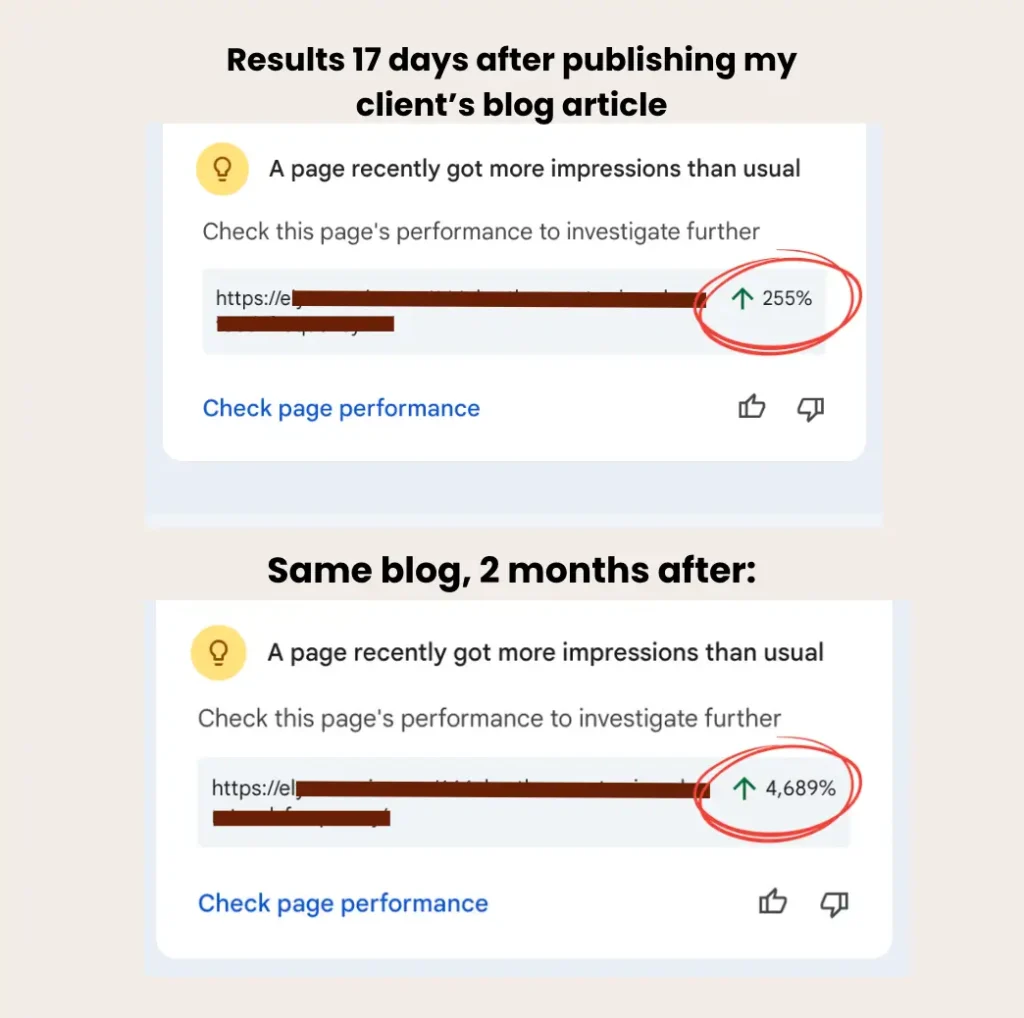
Some posts start showing impressions within weeks. Consistent results usually build over a few months as search engines and AI tools index your content.
The sooner you start, the sooner your clinic shows up when pet owners are searching.
You can see one of my client’s results as an example.
Do I need a big website for blogging to work?
No. Even a small website can benefit from well-structured blog content. It’s about quality and strategy, not size.
Can blog posts help with AI and voice search?
Yes. Clear, well-organized blog articles help AI tools and voice assistants understand your expertise and recommend your clinic. This is where search is heading, and blog content gets you ready.
Do I need to write technical articles?
If you write for pet parents, no. But if you write for peers, yes. A mix of client-focused and peer-level content works best, depending on your goals. If you want to attract more clients, focus there first, that’s what I highly recommend.
Do I have to keep blogging forever?
No. A focused strategy over a defined period can create long-lasting visibility without ongoing effort. You build it once, and it keeps working.
Ready to make your blog work for you?
If you want blog content that brings new clients to your clinic without relying on social media, here’s how it works.
I write strategic, SEO-optimized blog posts that help your clinic get found by the right people at the right time (especially at 2am when they’re worried about their pets vomiting for the 2nd time).
I’m not into fluff or generic advice. Just clear, effective content that reflects your expertise and brings clients through your door.
See how my blog copywriting service can bring clients to your clinic, book your free call below to see if it’s the right fit for you.