Your About page has one job: make website visitors want to work with you by building trust and connection so they become your clients.
It’s one of the most visited pages on your site. The place where prospects come to check if you’re the right person to help them. The page that makes the difference between “I’ll keep looking” and “Yes, this is definitely the person I want to work with.”
Yet 95% of About pages are boring and missed opportunities to create an authentic emotional connection with visitors.
Grab your coffee and let’s dive in. You might want to bookmark this page so you can find it easily later.
- What prospects are really looking for on your About page
- Why most About pages don’t work
- How to avoid a “cold” page and create connection instead
- What your brain makes you believe (but it’s wrong)
- The test that reveals if your “About me” page works
- Grab your FREE guide for an effective “About” page
- Why your about page is crucial for your business
- FAQ
TL;DR – Key Takeaways
- Create connection, don’t just present: Visitors want to know if you can help them, not read your resume.
- Reassure instead of prove: A well-told story beats 15 listed degrees.
- Show your personality: If someone can copy-paste your page to your competitors’ sites, it doesn’t represent you enough.
- Talk like real life: Skip the technical jargon, express yourself naturally to create connection.
- Test effectiveness: Have 3 strangers read your page and ask if they understand what you do and why they should trust you.
What prospects are really looking for on your About page
No, it’s not your resume.
When someone clicks “About,” they’ve already visited at least one other page of your website. Maybe they read a blog post, looked at your services, or landed there from Google.
In their mind, one question: “Can this person actually help me?”
They’re not looking for your life story. They want clues to know if:
- You REALLY understand their problem
- You’ve helped people like them before
- They can trust you with their problem
- They’ll actually enjoy working with you because they need to feel connected to you or that they can relate to you to an extent.
Your About page is giving them a confirmation that you’re the right choice for them.
Why most About pages don’t work
Presenting and Connecting are two different things
❌ Most professionals think their About page should… present them. Nope… at least, not in the “traditional way”.
✅ It should create connection. Huge difference.
Presenting = “Here’s who I am, what I’ve done, my skills” –> leads with “I”
Connecting = “Here’s why I understand your problem and how I can help” –> leads with “YOU”, reader-oriented
Writing to prove instead of reassure
You list 15 diplomas thinking that will convince and reassure people about your skills…
Except your prospects are stressed about their problems and aren’t going to count your certificates or qualifications…
They might not even understand the acronyms or abbreviations (and that’s normal – it’s not their field). They just want to know if you can get them out of their situation with your expertise and experience.
Writing to prove: List all your degrees.
Writing to reassure: Tell how you helped someone in their exact situation, and even how you lead yourself from point A to point Z.
Forgetting your reader might be scared or intimidated
The fear of making the wrong choice, wasting time or money gets added to their original problem (= the reason they need you in the first place).
If you’re a divorce attorney, your prospect is already going through something painful. They need to know you’ll fight for their rights beyond just having a degree that makes you qualified.
If you’re a veterinarian, your prospect worried about their pet wants the best for their companion. They need to feel you’re caring, that you’ll provide the best care, and understand why YOU are the better choice over your competitor.
Your About page should calm these fears and transform them into “I have a good feeling about this expert.”
Create that emotional connection and you’ve won.

How to avoid a “cold” page and create connection instead
Don’t use technical language, speak your client’s language instead
Example: ❌ “With 15 years of experience and mastery of the latest technologies…”
Your prospect just needs their website to work and bring them clients. “Mastery of latest technologies” doesn’t clearly show you can solve their specific problem.
✅ “Tired of having a beautiful website that nobody finds? I fix that.”
Show your personality, no more blending in
If someone can copy-paste your About page onto any competitor’s site, you haven’t added your personal touch.
Your prospects choose a human being, not a machine.
My advice: on your About page, express yourself like you’d talk to people in real life. Give yourself permission to drop the formal stuff. Be natural.
Show concrete proof and real results
Without testimonials or stories about your clients’ experiences, your expertise is less compelling.
When we hear or read someone’s story, the human brain makes us visualize ourselves in that situation.
If I say: “It’s mind-blowing how thinking about something makes you see it everywhere. When I bought my first car – a Micra by Nissan, I saw them everywhere.”
I’m sure reading that sentence made your mind automatically recall a memory of a similar experience. Maybe not with a Nissan specifically, but maybe a dog breed, a pair of shoes, etc.
Well, testimonials work the same way.
“I’ve helped many clients” is way more vague than “I helped my client, a 90s Artist, move her site from page 9 to the first page of search results. Now her site works for her even when she’s touring the world.” (true story, by the way)
Even if you’re not a 90s artist going on world tours, I bet you thought “amazing, I’d love for my site to work for me on Wednesday afternoons when I take time off with my kids…” Right?
What Your Brain Makes You Believe (but it’s wrong)
We’ve all unfortunately had a negative experience with a credentialed professional, right? Which is the proof that certificates and titles don’t prove anything.
“My diplomas prove my competence”
Our diplomas and certificates prove we know theory.
Our clients’ results prove we know how to apply that theory to solve real problems.
Guess which one is more reassuring?
“I Need to Stay Professional”
Professional doesn’t mean “robotic” or “closed off.”
You can be serious about your work and human (more personal) in your communication.
Actually, your best clients are often those who see themselves in your personality.
I always recommend adding anecdotes and facts, because it creates sympathy and connection opportunities.
We work more easily with someone we recognize ourselves in. It’s reassuring. It’s human. We’re social creatures.
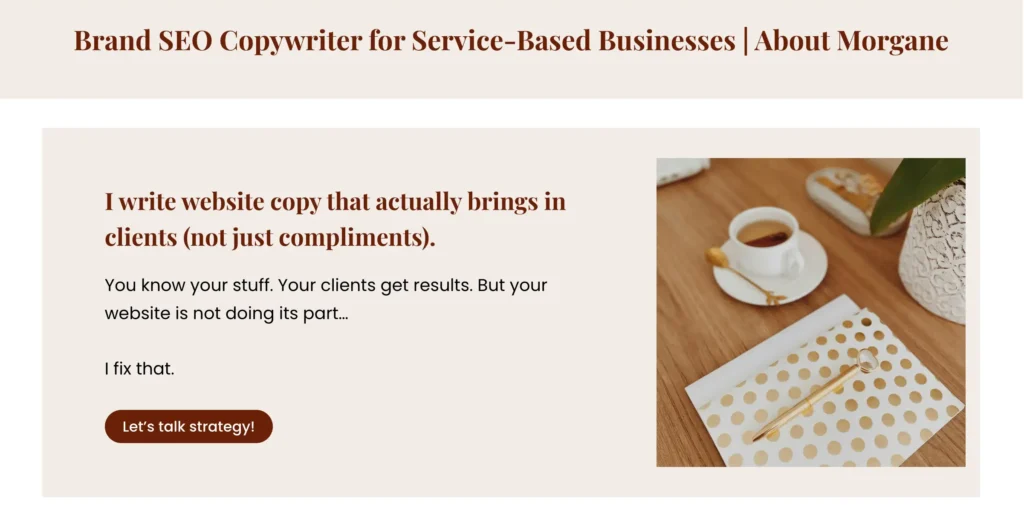
If you look at my About page, you’ll see toward the end I’ve added anecdotes (and a picture of myself in my “natural habitat”: headphones on, messy bun with birds on my head)…
Not to tell my life story, but strategically to create connection, share my somewhat unique story, and my values. You’ll also see how I tie some of them more or less directly to what I do to reinforce my marketing message and authority.
Here’s a concrete example of professional vs connection:
A family law attorney writes: “With a Master’s in Private Law from University of Texas obtained in 2003, I handle divorce proceedings, parental authority, and matrimonial property liquidation.”
➜ This shows skills, yes, but creates zero connection.
Now read this:
“My parents divorced when I was 10. I saw firsthand what it’s like to feel bounced around without ever understanding what was happening. Today, I defend families so no child feels set aside during conflict. My job? Find balanced solutions that protect your rights even when things get tense.”
➜ There, you open a door. You speak truth. You include your reader in your story, you show them you understand what they’re going through and that you want the best for them AND their children.
See the difference? One builds walls, the other builds bridges.
“Well Yeah, But Everyone Does It That Way”
Exactly. And that’s why 95% of About pages are forgettable.
If everyone does the same thing, doing it differently becomes your advantage. It’s your opportunity to become memorable.
The test that reveals if your “About me” page works
Have 3 people who don’t know you read your About page.
Time 30 seconds, then ask:
- “What exactly do I do?”
- “What problem do I solve?”
- “Why would you trust me?”
If at least 2 out of 3 can’t answer precisely, your page isn’t doing its job.
But don’t panic!
Grab your free mini-guide that will help you write an About page that ACTUALLY works!
It’s YOUR time to stand out
Look at your competitors’ About pages. Now that you’ve read this article, you’ll more easily spot opportunities to stand out.
Look at what’s missing:
- Do you understand who they really are?
- Do you feel a connection, a real personality, clear intention behind the words?
Often, it’s a no. And that’s great for you, because by telling your story simply, with the right elements in the right places, you immediately create connection and stand out.
No need to overdo it: a human tone, useful information, and a well-placed touch of emotion are enough to make the difference.
Once you’ve written it, reread your page as if you’re a visitor who doesn’t know you. If it seems vague, too self-centered, or cold, adjust until you feel your page actually represents you.
Why your about page is crucial for your business
An effective About page means:
- Better qualified prospects: They understand what you do before contacting you. No more answering the same basic questions over and over.
- Easier sales: They arrive already convinced you can help them.
- Stronger expert image: A well-written About page = perception of a professional who knows their stuff.
- Less price competition: When they choose you for who you are (not just what you do), price becomes secondary.
What a good About page actually does for your website
A professional About page doesn’t just describe what you do. It:
- Speaks directly to your ideal client’s specific problems
- Positions you as the obvious solution
- Builds trust and credibility
- Handles common objections before they come up
- Guides visitors toward hiring you
When done right, your About page becomes your best salesperson. It explains your value, builds trust, and converts visitors while you sleep.
The Bottom Line
Your About page should work for you 24/7, building trust and making people want to hire you. If it’s not, you know what to fix.
The good news is that this is completely fixable. With the right words in the right places, your About page will start converting visitors into clients.
Ready to write an About page that actually converts visitors into clients? Download my free About Page Guide that shows you exactly what to include, what to skip, and how to structure it for maximum impact.
Download your free guide here:
How to write an About page that makes people want to work with you
Wanna go deeper?
Inside Sold Out SEO, my 6-month program with live support, you’ll learn how to write an About page that converts visitors into clients, along with all your other website copy. You’ll also learn how to optimize your site so the right people find you on Google.
See you!
Morgane
FAQ – How to write an About page that makes website visitors want to work with you
Write in first person (I, me, my) because it creates connection and feels more human. Third person (she, he, they) creates distance and makes your page sound like someone else wrote it, which feels corporate and cold. Your About page is where people decide if they want to work with you as a person, so speaking directly to them in your own voice builds trust faster than referring to yourself like you’re reading a bio.
Long enough to create connection and answer the questions visitors have, but not so long they get bored. A good About page is usually 500 to 1000 words (the bare minimum that makes Google happy is 300, but I personally always target 500, ideally 800 as a minimum). Focus on quality over length. If every paragraph creates connection, builds trust, or shows you understand their problem, keep it. If you’re just filling space with credentials or rambling about your journey, cut it. The goal is to make them want to work with you, not to tell your entire life story.
Put them toward the middle or end, not at the top. Start by speaking to your visitor’s problem and showing you understand them. Once you’ve created connection, then mention relevant credentials as proof you know what you’re doing. Lead with reassurance (I’ve helped people like you), then back it up with credentials. Try to weave your credentials in naturally if possible, instead of having a resume-like block. Starting with degrees and certifications makes your page about you instead of them, which is why most About pages fail.
A bio lists your background, credentials, and career history. An About page creates connection by showing you understand your visitor’s problem and can help them solve it. Bios are me-focused (here’s who I am), About pages that sell are you-focused (here’s why I can help you). Your About page should include some biographical elements, but the structure and tone should focus on making visitors feel seen, understood, and confident you’re the right choice.
Yes, if they create connection or show your values. Personal anecdotes make you human and memorable instead of just another professional in your field. The key is making sure the story ties back to why you do what you do or how you understand your clients. Don’t include random facts just to fill space, but strategically chosen personal details help visitors see themselves in you and feel more comfortable working with you.
Related articles:
Blog updated in February 2026