You paid an SEO agency, you waited, you checked your traffic every week, and… not much happened. Maybe a few more visitors, but none of them booked, or maybe your position on Google went up slightly, then dropped again. The agency has probably sent you a report full of graphs that looked impressive, but these meant absolutely nothing to your bank account.
I get how frustrating it is to make a business investment and not seeing any return on investment. That’s a very specific kind of frustrating.
So before you blame yourself for this decision or start wondering what other strategy you should try next, this article will explain why that happens so often, what’s actually missing, and what a visibility strategy looks like when it’s built specifically for how service businesses actually work.
Here’s what we’ll cover:
- What SEO agencies actually do (and what they don’t)
- The real specificity about service-based businesses
- The difference between getting found by anyone and getting qualified visitors
- The strategy that works for service providers: visibility plus copy
- How to build this yourself without starting from scratch
- FAQ
TL;DR
Most SEO agencies focus on rankings (getting your website to show up) and traffic, but rankings don’t pay your bills, clients do. Service businesses need visibility that attracts the right people AND copy that sells. When those two things aren’t built together, you get traffic that goes nowhere. The fix isn’t a bigger agency budget but an effective system built around how your buyers actually search, think, and decide to work with you.

What SEO agencies actually do (and what they don’t)
Let’s be clear: SEO agencies aren’t scamming you. Most of them are doing exactly what they were hired to do. The problem is that what they do and what your business actually needs are often two different things.
Here’s what a typical SEO agency delivers:
- keyword research based on search volume, backlinks to increase your domain authority (basically getting your websites listed on other websites),
- technical fixes to make Google crawl your site better,
- monthly reports showing impressions, clicks, and rankings (that is to say your position on Google).
All of that is real work and it’s useful, but what’s missing from that list is copy that actually convinces someone to hire you.
An SEO agency will get people to your website, but they won’t make those people want to book a call with you or pay for your services.
But here’s what’s not their job:
- writing compelling words on your homepage,
- explaining clearly what you do, for whom and why it matters,
- creating blog posts that answer your clients’ real questions and build trust before anyone even reaches out.
So this creates a gap between “someone landed on your site” and “someone became your client”. And that gap is exactly where most service businesses lose clients, opportunities, sales and… money.
The real specificity about service-based businesses (that an agency often misses)
If you sell a product, getting traffic is most of the battle. Someone searches, clicks, sees the product, reads the reviews, adds to cart. The page does most of the selling on its own because the product is tangible.
Service businesses are different.
Whether you’re a lawyer a therapist, a business consultant, a vet or a designer, you’re asking someone to trust you with their legal case, their mental health, their business, their animal, their creative vision.
That’s more than an “add to cart” decision. That’s a “Can I trust this person can actually help me?” kind of decision.
And that decision happens on your website, through your words, before anyone reaches out.
So when an SEO agency sends traffic to a homepage that says something like “I help businesses grow with tailored solutions,” that visitor lands, reads nothing that speaks to them, and leaves. The traffic was real, but resulted in a lost opportunity.
So you see, in this case traffic isn’t problem. It’s a copy and positioning problem, and most SEO agencies don’t touch that.
The goal: getting bookings from your website 24/7
On a late Friday afternoon, I was on my treadmill taking a break. I showered, came back to my desk, and had a booking notification waiting for me. A vet who wanted a website audit had found one of my blogs, decided I was the right person, and booked, without me doing a single thing, just because my website is set to not only get found, but also get clients.
The following Sunday night at 11:02pm, right as I was going to bed, a six-figure business owner booked an audit too.
I wasn’t posting on social media, I wasn’t engaging in the comments, I was definitely not filming a behind-the-scenes Reel to please the algorithm. I was living my life.
My website does the selling because that’s why I built it to do: show up when someone searches, speak directly to what they’re dealing with, and make booking feel like the obvious next step.
That’s what SEO looks like when it’s built for a service business: the right person finds the right words at the right moment.

The difference between getting found by anyone and getting qualified visitors
Here’s a question worth sitting with: would you rather have 10,000 monthly visitors who read one sentence and leave, or 200 visitors who stay, read, and half of them reach out?
Getting found by anyone doesn’t bring revenue. Getting found by qualified visitors is what does. And by “qualified visitors”, I mean people who searched for something specific, found your site, read it, felt understood, and decided to take action.
In other words: Would you rather have your site show up for 1) searches that your ideal clients are actually making or for 2) high-volume keywords that bring curious browsers?
If you answered option 1, the difference is in your copy.
For your website to show up for keywords your ideal clients are searching your copy needs to speak to the specific problem they’re facing right now. And your content needs to guide them from “I found this website” to “I’m booking a call with this expert.”
When an agency optimizes for your website to get more visitors without considering who those visitors are and what they need to read when they arrive, you end up with people who have no intention of becoming clients.
What SEO agencies often get wrong for service businesses specifically
This is not about blaming anyone but raising awareness about what’s a fit for your service business.
Most SEO agencies work with a model that was built for e-commerce, SaaS, or large businesses with marketing teams.
The metrics that matter in those contexts (domain authority, impressions, click-through rates) are not the same metrics that matter when you’re a therapist or a vet wanting to book out your practice or a consultant trying to attract high-paying clients.
Here’s where the mismatch usually happens when a service business hires an SEO agency:
- Keywords targeted by volume, not by search intent.
A keyword with 10,000 monthly searches sounds exciting until you realize those searchers are mostly students doing research, not buyers looking to hire a service provider.
The keywords your actual clients type are often more specific, less glamorous, and far more valuable. In other words, that’s where the money is.
- Ignoring the copy entirely.
Your homepage, your services page, your about page, these pages are supposed to turn visitors into clients. If the words on those pages don’t speak to your specific client’s specific problem, no amount of traffic will increase your sales and income.
- Generic blog content.
Blog posts that cover super broad topics, like “5 tips to improve your marketing”, don’t position you well for competitive terms and don’t build the kind of trust that makes someone want to hire you. Specific, intentional, well-written content does both.
- Measuring success by rankings, not by bookings.
You can rank number one for a keyword and still get zero clients from it if the keyword was wrong or the page doesn’t sell. The only metric that matters for your business is how many qualified people reach out AND become clients.

The strategy that works for service providers: visibility plus copy
The businesses that consistently attract clients from Google aren’t necessarily spending more money on SEO and they’re not hiring expensive agencies either.
Instead, they’ve built something different: a system where being found and being compelling happen at the same time.
That system looks like this:
A homepage that filters immediately.
Within seconds of landing, the right person knows they’re in the right place. The wrong person leaves without wasting anyone’s time. No vague taglines, no “welcome to my website”, no fluffy statements. You need to be clear about what you do, who you help, what people will get in terms of results and what to do from there.
Service pages that remove doubt.
Before someone reaches out, they have questions. Can this person actually help me? Is this worth the price? What happens when I hire them? Your service pages need to answer all of that before they even ask.
Blog posts that meet people mid-search and that compound
When someone types “do I need a lawyer for my lease agreement” or “why does my dog keep scratching after vaccination,” they’re already looking for someone who understands their situation. A blog post that answers that question clearly and specifically builds more trust in five minutes than a month of social media posts.
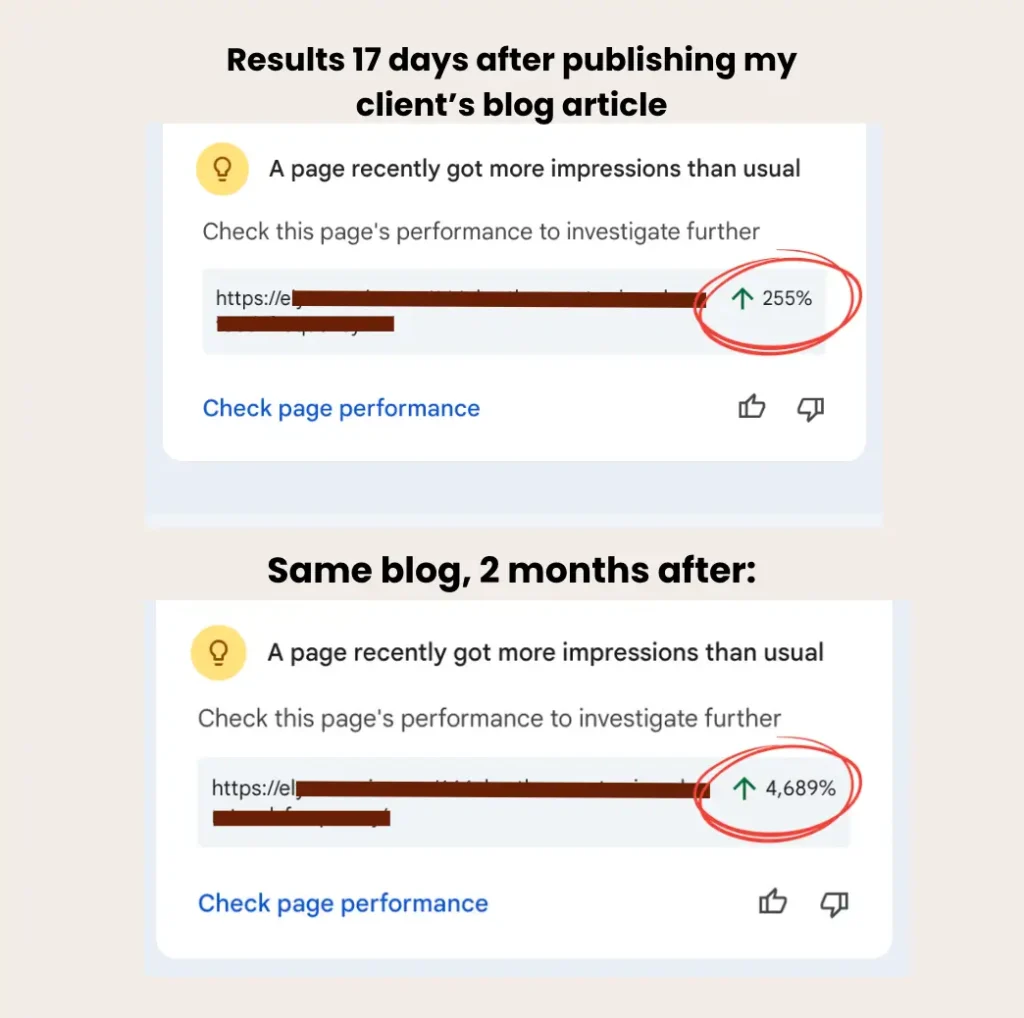
One well-written blog post that’s optimized for what your clients are actually searching will keep attracting people for months, sometimes years. You write it once, it works while you sleep, take weekends off, travel, or deal with life. Content that compounds is the real secret sauce every service provider should use in their business.
One of my clients’ websites was buried on page 9 of Google when we started working together. I optimized her homepage, rewrote her service pages, and published weekly blog posts targeting her clients’ most common questions. Three months later, 16 pages of her site were appearing on page one.
She didn’t pay a single penny to an agency, we built content with her ideal clients’ intent in mind and used the right words they needed to read to get answers to their questions.
How to build this yourself without starting from scratch
Here’s something agencies won’t tell you: small service business owners often get better results learning to do this yourself than outsourcing it to an agency that doesn’t deeply understand your clients, your voice, or what makes your approach different.
An agency writes copy for dozens of clients. They don’t know that your therapy practice specializes in expats, or that your legal clients are usually first-time business owners who are scared of making a mistake, or that your veterinary practice has a specific approach to anxious animals that sets you apart.
YOU know all of that. And when that specificity makes it into your copy and your content, it attracts exactly the right people because it speaks to exactly the right problem.
The part most service providers are missing is the system: knowing which keywords to target, how to structure a page so it sells, how to write blog posts that rank and convert visitors into clients, and how to put it all together so it keeps working for you, without you having to babysit it daily.
That’s a learnable skill. And once you have it, you own it. No monthly fees, no dependency on an SEO agency that moves on to the next client, no mystery about why something isn’t working.
The real question
You already have a website that’s paid for, sitting there, technically visible on the internet.
The question is whether it’s doing anything for your business, whether it shows up when your ideal clients search, whether it speaks to them when they land, whether it guides them to reach out… or not!
If the answer to any of those is “not really,” the problem isn’t that SEO doesn’t work. The real issue is that some pieces are missing and once you put them together, your website actually starts working for you.
Ready to make your website your most reliable client source?
Every month it’s not working is a month you’re filling that gap yourself, with your time, your energy, and your presence. Sold out SEO is my solution.
Sold Out SEO is a 6-month program with live support for service providers who want their website to bring in clients consistently without posting daily or depending on an agency to do it for them.
Inside, you’ll learn how to optimize your website so Google knows you exist, write copy that turns visitors into clients, create blog content that keeps attracting the right people long after you publish it, and build a visibility system that works across multiple channels of your choice, based on what actually fits your business and schedule.
You get weekly live calls, direct feedback on your website and content, ready-to-use templates, and a community of service providers building the same thing.
This is not a course you watch once and forget but a complete system you build with support, so it actually gets done and works.
If your website should be working harder than it is, this is where you start.
FAQ – Why hiring an SEO agency doesn’t work for most service businesses (and what does)
You can learn the concepts, yes. What’s harder to get from tutorials is knowing which pieces to prioritize for a service business. More specifically, how to combine SEO with copy so visitors actually become clients, and how to tell when something isn’t working and what to adjust. Free resources give you information. A structured system with feedback and guidance on how to apply it to your specific business gives you results.
A copywriter improves your words. That’s valuable, but if your site isn’t showing up in search results, better words won’t bring more people to read them. You need both visibility and compelling copy working together. Most copywriters don’t do SEO, and most SEO agencies don’t do copy. That’s exactly the gap my Sold Out SEO program fills.
That actually works in your favor. Specific (aka niche) and local businesses often face less competition for the specific searches their clients make. A family law attorney in Liverpool or a holistic vet in Bristol has a much better chance of ranking for their specific searches than a generic “business coach” trying to reach everyone everywhere.
Not necessarily. If you already have blog posts or website content, the first step is usually optimizing what already exists before adding anything new. Many service providers are sitting on content that could work for them with some adjustments. Starting from scratch is rarely the first move.
Blogging without an SEO strategy is like putting up a billboard in a dead-end street in a small village. The content exists, but no one outside your existing audience ever finds it. If your posts weren’t bringing clients, the issue is almost always either that you were targeting the wrong keywords, the posts weren’t structured to convert readers into inquiries, or both and that’s what Sold Out SEO will help you fix.
Yes, and definitely more so. AI search tools like ChatGPT, Perplexity, and Google’s AI overviews pull from content that is already well-structured, clearly written, and genuinely useful. The same principles that make content rank on Google make content get referenced by AI tools, namely: specificity, clarity, answering real questions. Building your content strategy around your clients’ real questions is exactly what positions you well in both.
That’s worth looking at honestly. Every month your website isn’t attracting clients is a month you’re relying entirely on referrals, social media, or word of mouth, all of which require active effort from you. Your website is already there. The question is whether it’s bringing you clients and money or just existing.
For any questions about your website, your marketing strategy or Sold Out SEO, book your free mini website audit to get clarity on what’s the most urgent fix for you right now and how to get more clients more consistently.
See you soon,
Morgane