You can have a genuinely good offer, real expertise, and a website that looks amazing, and still have prospects land on your page and disappear without booking.
Not because they didn’t like what they saw, but because something felt unclear enough to make saying yes feel risky. And when something feels risky, the brain says “not yet”. And not yet almost always means never.
In this post, we’re covering:
- The emotion myth: why feeling good about you isn’t enough for a prospect to become client
- The four things that actually make prospects say yes
- Why your content is either working for you or taking up space
- What a website that converts prospects into clients looks like
- How to see your own website the way a stranger sees it
- What happens when you fix both the visibility and the copy
- FAQ
TL;DR
Prospects say yes when your website reduces risk, not when it sounds good. That means being specific about who you help, making your offer impossible to misunderstand, showing proof people can see themselves in, and giving them a next step that doesn’t feel scary. Do that, get found on Google, and your website will start doing the selling for you.

The emotion myth: why feeling good about you isn’t enough for a prospect to become client
There’s a version of marketing advice that says: make people feel enough and they’ll buy. And it’s not completely wrong. Emotion gets attention, creates connection, and makes someone stop scrolling and think “oh, this might be for me.”
But emotion alone is not what sells when you’re a service provider selling your expertise. Treating it like it does is one of the most common reasons service providers end up with a beautiful website that brings in almost nothing.
Here’s what actually happens when a prospect lands on your page.
First, they feel something: curiosity, recognition, a little spark of “this could be the solution I’ve been looking for”.
Then immediately, almost without realizing it, they start looking for reasons not to buy. This isn’t them being difficult, cheap or “not ready”. This is their nervous system doing exactly what it is supposed to do. Every purchase, especially a high-ticket service, feels like a risk, and the brain’s job is simply to reduce risk before saying yes.
So they start asking quiet questions, like:
- Is this actually for someone like me, or is this a generic offer dressed up in nice words?
- Am I really getting what I think I’m getting, or am I going to have to send three emails to figure it out?
- What happens after I click?
- Has this worked for someone who’s in the same situation as me?
If your website doesn’t answer those questions clearly, the emotion fades, they close the tab, and you never find out they were even interested.

The four things that actually make prospects say yes
So what makes it safe for prospects to say yes? Four things, and none of them require you to be a copywriter. They just require you to look at your website from the outside instead of the inside.
Relevance
Within about three seconds of landing on your page, your prospects need to feel that this is specifically for them. Not for “entrepreneurs who want to grow”, nor for “anyone who wants to reach their full potential”. But for them, their exact situation, and specific problem.
The more precisely you describe who you help and what their life looks like before they work with you, the more the right prospects thinks “this person gets it”. And the more people who aren’t a good fit will self-select out, which is not a failure! It’s actually the whole point.
Vague copy feels like shouting into the void, while specific copy feels like you have done this before and you know exactly who needs it.
Clarity
If someone has to think to understand your offer, they won’t. They’ll assume it’s too complicated, that it’s probably not for them, or that they’ll figure it out later. But later never comes.
Clarity means they know what the offer is, what they get, what changes for them on the other side, and what to do next. All of that, without scrolling three times or sending an email to ask.
A therapist I worked with had his website for three years. People visited but none of them booked directly from his website. After we worked on the copy and structure together, he had bookings within two months and a click-through rate of 10% in an industry where 4 to 6% is considered strong. (The click-through rate is the ratio between people who see his website and those who actually click to visit it from Google). His services didn’t change, nor did his techniques, the clarity of his website did.
Proof
Not generic testimonials, but specific, outcome-based proof that a prospect can see themselves in.
“Amazing service, highly recommend” does almost nothing for someone who’s on the fence. What moves them is a result that feels real and relevant. Like for example in my case, here are some of my clients’ results:
- a vet got 150% more phone calls and 17% more contact form inquiries within two months,
- a coach got a client into her 8-week program from the very first email in her sequence, no discovery call needed,
- or a course creator whose website copy finally reflected her expertise and started attracting the right clients without her having to explain herself or go on discovery call.
Those results are specific enough to be credible and concrete enough to make someone think “if it worked for them, it could work for me too”.
A next step that doesn’t feel like a trap
Your call to action is not just a button, it’s a roadmap that takes them to the promise. And if that roadmap feels vague or risky, people won’t click it.
“Get started” says nothing. But when I say “Book a free 20-minute audit, I’ll review your site before we talk and show you exactly what’s holding you back from getting bookings from your website” tells them everything they need to know. They’re aware of what they’re walking into, they know it’s free, a quick and valuable win. They know they leave with something useful even if they don’t hire me.
That’s a low-risk next step, and that’s the kind of button that gets clicked.
If you want to know exactly what’s holding your website back right now, that’s what the free mini audit is for. I review your site and your Google presence before we get on the call, then we spend 20 minutes on Zoom going through what’s costing you clients, whether that’s vague copy, an SEO issue, a confusing layout, or all of the above. You leave with a clear picture of what to fix, no pressure, no pitch.

Why your content is either working for you or taking up space
Most people think about social media content as a visibility tool. You post, you get seen, someone follows you, maybe eventually they buy. And that can work, but it’s slow, it’s unpredictable, and it stops the second you stop posting.
There’s another way to think about content: not as a broadcast but as a conversation happening at exactly the right moment, without you being in the room.
When someone searches Google at 2am because they can’t sleep and they’re stressed about that very problem to which you have the solution, and your blog post is the answer they find, that’s not a simple visitor. That’s a prospect who’s already aware they have a problem, looking for a solution, and has just landed on your content at exactly the right moment.
Your job at that point is to be relevant, clear, credible, and give them a logical next step.
That’s it. No dancing on Reels, no daily posting, no searching for the next trend to entertain anyone and definitely not hoping to have the algorithm gremlins’ favors.
A blog post that shows up on Google works 24/7:
- on a Tuesday afternoon when you’re with a client
- at 2am when someone can’t sleep,
- six months from now when someone finds it through a search.
You write it once and it has a conversation with your ideal client on repeat. See it like a passive sales conversation, and it’s one of the most underrated tools in a service provider’s marketing toolkit.
The reason most service providers don’t have this is that their website isn’t optimized to be found, and even when people do find it, their copy doesn’t do enough to make them stay, trust, and book.
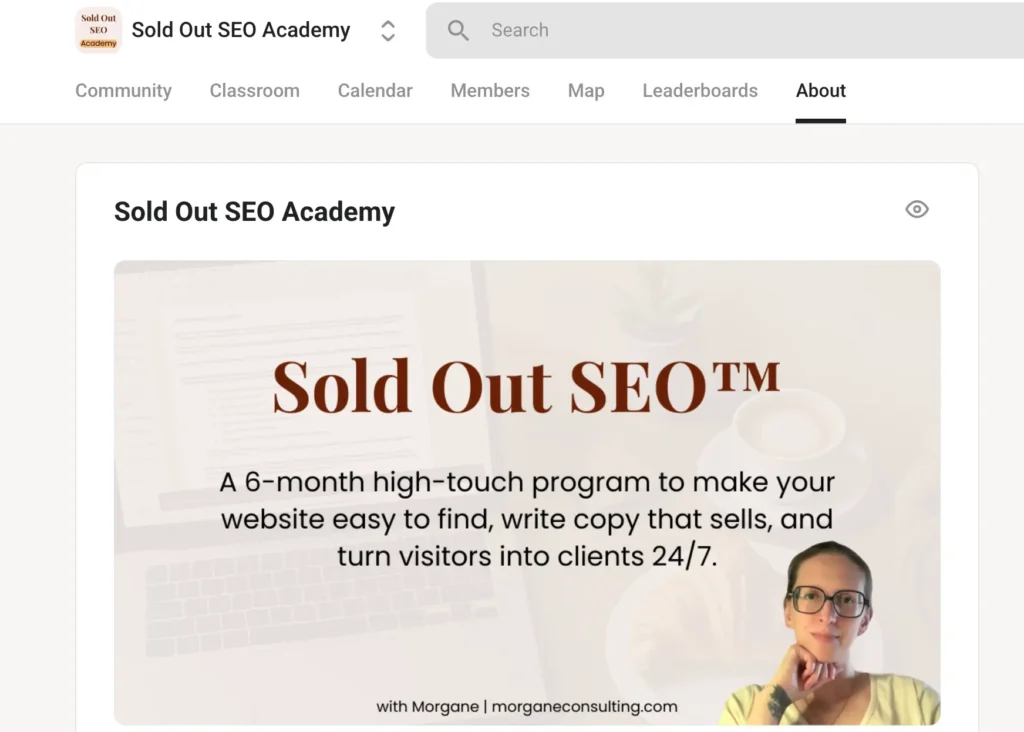
Both problems are fixable. And that’s exactly what my program Sold Out SEO is built for.
What a website that converts prospects into clients looks like
A converting website doesn’t necessarily have the most modern or breath-taking design. And it’s not the right font or a perfect image that “reflects your brand energy” that will make someone become your client. Those things are nice but they’re not what makes someone book.
A website that converts prospects into clients answers the right questions in the right order.
Here’s what it does:
- Tells visitors immediately what you do and who it’s for,
- Makes them feel seen before it asks them to trust you,
- Shows them the proof that it’s worked for people like them.
- Gives them direction about what to do next and removes the fear of doing it.
- And before all of that, it shows up when the right people search for it. Because a perfect website that nobody finds is just a very pretty business card sitting in a drawer.
I spent years in corporate before building my own business. I also spent money on the wrong courses, followed the influencer business model without realizing it, and burned out trying to be consistent on social media.
When I rebuilt everything from scratch following the expert business model, the shift was clear: your website should be working for you, not the other way around.
My own brand-new domain went from position 62 to position 28 in under six months, with 16 out of 34 pages already on Google’s first page. And that did NOT happen because I posted Reels every day (I definitely didn’t, I actually deleted my Instagram account, can’t be bothered). It happened because I used a system that actually works.
That system is what I teach inside Sold Out SEO.
How to see your own website the way a stranger sees it
This is the exercise most people skip, and it’s the one that changes everything.
Go to your website right now and read it like a stranger. Not like someone who built the offer and knows every detail of what it does. But like someone who landed on that page for the first time, has never heard of you, and is trying to figure out in ten seconds whether this is worth their time or not.
Ask yourself:
- Within three seconds, can I tell exactly what this is, who it’s for, and what changes for me if I buy it?
- Is there a clear, specific next step that tells me what happens after I click?
- Is there proof that this has worked for someone like me?
If any of those answers are “no” or “kind of” or “I think so,” that’s where you’re losing clients.
The first time I did this exercise on my own coaching website in my first business, my honest answer was “I have no idea what this page is selling”. That was a real wake-up call (more like a slap in the face). But it was also the thing that pushed me to learn what actually works, which eventually became the foundation of everything I teach and help my clients with.
And the best part is that you don’t have to figure this out alone. If you want a second pair of eyes on your website before you change anything, the free mini audit serves that exact purpose. I look at your site, identify what’s costing you clients, and give you a clear picture of what to fix first, whether you want to fix it yourself, learn how to fix it inside Sold Out SEO or that I fix it for you. Book your free 20-minute website audit here.
What happens when you fix both the visibility and the copy
The results I see when clients work on both SEO and copy together are not subtle.
A veterinary client saw 77% more visitors, 150% more phone calls, and 17% more contact form inquiries within two months, without blogging at all.
Another client’s blog reached over 4,600 impressions two months after publishing, with a 255% increase in impressions in the first 17 days.
A coach converted a new subscriber into her 8-week program from the very first email in her sequence. No back-and-forth, no discovery call.
These results are what happens when your website is easy to find and your words make the right people feel like they’ve finally found the solution they were looking for.
That’s the whole purpose of Sold Out SEO. It’s a 6-month program for service providers who already have a website, already know they’re good at what they do, and are done guessing why it’s not bringing clients.
Inside, you’ll learn how to:
- Write website copy that speaks directly to your ideal clients (and yes, we’ll also cover how to define or refine who your ideal client is)
- Make every page of your site easy to find on Google,
- Write blog content that brings in qualified prospects months after you publish it,
- Build an email list that works as a safety net if any platform disappears,
- Track what actually matters without drowning in confusing dashboards.
All of this in a non-overwhelming way and with ongoing support. You get weekly live calls, direct feedback on your website and content within 48 hours, a private community, and templates so you’re not starting from scratch.
FAQ – Why prospects don’t trust you yet
Yes, and it’s actually becoming more important. AI search tools like ChatGPT, Perplexity, and Google’s AI overviews pull answers from content that is already ranking well and structured clearly. If your website is optimized for search, it’s also better positioned to show up in AI-generated answers. SEO and AI search are not competing, they work from the same foundation.
It depends on where you’re starting. Copy changes can have an immediate effect on conversion, meaning the same number of visitors starts booking more. SEO results typically take two to six months to build up (six month is for newer domain names), but once they’re there, they compound over time. The clients mentioned in this post started seeing concrete results, like more inquiries from prospects and more phone calls to book, within two months of making changes.
No. Sold Out SEO is specifically built for people who already have a website. You work with what you have, optimize it, and build from there. Starting over is almost never necessary.
No. The program gives you frameworks, templates, and direct feedback on what you write. You don’t need to be a copywriter, you just need to be willing to show up and implement, even at an imperfect pace.
You can totally do that. Sold Out SEO has a full module on making social media work for you if you choose to use it, specifically by optimizing your profiles to drive traffic to your website instead of keeping people on the platform. You’re not told to quit social media, you’re shown how to stop depending on it if you don’t particularly enjoy it.
Ads stop the moment you stop paying for them. SEO builds over time and keeps working without ongoing expenses. A blog post that shows up on Google can bring in clients for years. An ad campaign stops the day your budget runs out. For service providers who want a long-term client source they own, SEO is the more sustainable investment.
Yes. Local SEO is one of the most powerful tools for brick-and-mortar service businesses. When someone searches “therapist in (city)” or “vet near me”, your website is either showing up or it isn’t. Sold Out SEO covers the principles that apply to both local and online businesses.
If your website has been sitting there quietly while you do all the work, this is where that changes.
Start with the free audit if you want to know exactly what’s holding you back from converting prospects into clients before committing to anything.
Or jump straight into Sold Out SEO if you’re ready to build the visibility system your expertise actually deserves.
Either way, you leave knowing more than when you arrived.
Book your free 20-minute website audit | Explore Sold Out SEO