Quick answer
You don’t need social media to grow your email list. A well-built freebie, an SEO-optimised landing page, guest collaborations, podcast appearances, and bundles can all bring the right people to your list consistently, without you posting every day. The key is building assets that keep working after you’ve created them, so your list grows even when you’re not actively promoting anything.
You’ve been doing your best: posting consistently, creating content, trying to stay visible because you’re told that’s the only way to grow your email list.
But social media content disappears fast. When you stop posting because you’re busy with clients, on holiday, or simply exhausted, you stop getting new subscribers, and… you’re wondering where your next enquiry will come from.
Your email list should grow through assets that keep bringing the right people to you long after you’ve created them. Because unlike social media followers, your email list is an audience you actually own.
Every person who joins your list chooses to hear from you, that’s how you build a trust-based relationship instead of relying on an algorithm to decide who sees your content.
If you’re ready to grow your list without posting every day, here’s what we’re covering:
- Why growing your email list is more important than growing your social media followers
- What a freebie is and why you need it to grow your email list with potential clients
- 5 Strategies to Grow Your Email List Without Social Media
- What to do once your email list is growing
- FAQ
Why growing your email list is more important than growing your social media followers
Your Instagram followers and LinkedIn connections don’t belong to you. If those platforms disappeared or deleted your account tomorrow, you’d have no way to reach the people you spent months or years building a relationship with.
My Facebook account has been restricted for no valid reason or clear explanation. One of my clients had his Facebook page deleted without warning or explanation either. He lost years of content and visibility just like that (well, he didn’t really care much because his website is working for him, but it still sucks).
My point is: if your email list growth depends entirely on social media, you’re one bot tantrum away from starting over from scratch.
Your email list is different because those who subscribed gave you their email address in exchange for a free resource they were interested in. They said yes to entering in a “communicationship” with you (yes, I made that word up), no algorithm can take this away from you, no engagement rate will determine whether they seen your content or not.
I don’t know about you, but I’d rather have an email list of 600 people who genuinely want to hear about what I offer, than 2000 social media followers who won’t see all my posts because the algorithm might not show it to them that day.
Now, I’m not saying social media can’t grow your email list or that you have to stop using it completely. However, there’s a way to set it up strategically so it can send those who find your account to your email list, even if you rarely (or never) post.
There’s a more efficient and reliable way to build your email list.
What a freebie is and why you need it to grow your email list with potential clients
What a freebie is
A freebie (or lead magnet) is a useful resource that you create, like a checklist, guide, template, or mini training and that you give away for free. The goal is that your potential clients get a quick win and see what solving their problem could look like, specifically with your approach.
In order to access it, they fill in a simple form (usually their name + email address + the GDPR consent box to tick to confirm they want to hear from you). You get a new subscriber, they get your free resource. They can unsubscribe whenever they want (even if we all hope they won’t, it happens and it’s ok).
For example, I created a free website audit checklist for service providers who want to find out why their website isn’t bringing them clients so they can have an idea of what to fix, whether they want to do it themselves, learn with me or have it done for them.
Your freebie should attract future clients, not just subscribers
There’s a difference between growing your email list for the sake of it… And growing your email list with the right kind of subscribers, meaning people who are serious about solving their problem, not just collecting free stuff.
While I’m aware you can’t always guess people’s intentions and motivations, there are ways to filter out who you’re talking to, not only with your landing page copy (more on that soon), but also with the way your free resource itself is built.
Most people create a freebie based on what they think will get the most downloads. They choose a broad topic that sounds useful, create a PDF or a masterclass, give it a vague title, and then focus on getting as many email addresses as possible.
But then, they wonder why the people downloading it never become clients. Well, the problem is that their freebie wasn’t built to lead people towards a clear action, or make your offer a no-brainer next step.
You need to make your free resource appealing and to give value. Most freebies get downloaded because they sound cool, but downloaded doesn’t mean they’ll be open. Many end up in people’s “freebie graveyard” (aka the “download” folder) and that’s not what you want. You obviously want people to download it, open it, apply it and get a quick win.
A freebie that grows your client list is built differently and strategically, using a method I came up with and that I call “The Reverse Sell Method”.
When a freebie is built following this method, the people who download it are already pre-sold on your approach before they’ve spent a penny. They go from cold (total strangers) to warm (interested), if not hot (ready to buy).
I teach about my Reverse Sell Method in the “Create a freebie that pre-sells your offer” workshop and I also give you 3 formulas to pick a title that makes people want to download it. You can explore it here.
Let me show you what a vague and broad freebie looks like compared to a clear and specific one:
- A freebie like: “50 Instagram caption ideas for your business” might attract a lot of people who need help writing their captions.
But what kind of captions for what kind of content? What’s the goal of the content? This is vague, you’re not sure who it’s for exactly: service providers? product-based businesses? Influencers? What’s their goal beyond writing better captions? We don’t know.
- Now compare that with: “Website audit checklist: Find out what’s stopping potential clients from booking with you”.
This is designed for service-based businesses. Someone who downloads that is already thinking about their website, their visibility, and why they aren’t getting enough enquiries. In other words, they have a problem you solve.
The first from this example freebie grows a list with different kinds of people. The second one starts a relationship with someone who could become a client.
Your freebie should go beyond giving people something useful.
It also should help them understand a problem they have, experience a quick win, and see why your approach is the logical next step.
That is how you build a list that supports your business… But building the freebie is step one. Getting the right people to find it is what makes it actually grow your list. And the very first step in order to do that is to create a dedicated page on your website, called a “landing page”.
Your freebie needs a dedicated page on your website: the landing page
Your freebie needs a landing page: a simple page where people can opt in to receive it.
Most service providers build that page quickly, give it a vague headline, and then rely entirely on social media to drive traffic to it, which means the moment they stop posting, the traffic stops too, as previously established.
A landing page that’s built with a specific title uses the words your ideal clients are already typing into Google. That means Google can understand what the page is about and match it to the right searches. People who have never heard of you can find your freebie because they searched for the problem it solves.
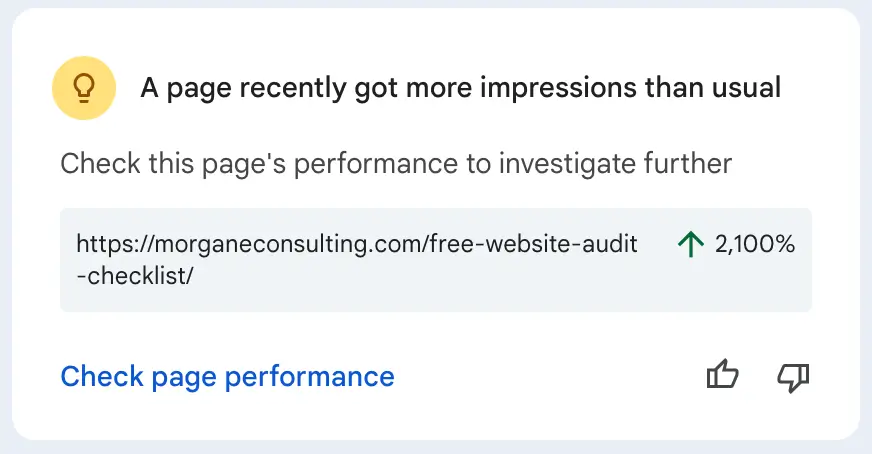
My own freebie landing page started getting impressions on Google within weeks of publishing it.
My domain was two months old at the time. I hadn’t promoted that specific page on social media yet and I didn’t run ads.
The page got 2100% more impressions in its first month because the title was specific and the copy was clear and matching the queries from people searching for the problem it solves.
Rozella is a career coach who worked with me at the end of 2024. She’s barely on social media and when she is, it’s LinkedIn only and she doesn’t actively promote her freebie. Her “should I quit my job” quiz is on page one of Google, and regularly brings her new email subscribers without her doing anything to promote it.
She has a click-through rate (ratio between the number of times her freebie appears in search results and people actually click on it) of 5.1% in an industry where the average sits between 2% and 4%. Her title and description are compelling enough for people to click before they’ve even landed on her page.
That’s what a well-optimised freebie landing page does over time: it promotes itself thanks to SEO (Search Engine Optimization).
In the “Create a freebie that pre-sells your offer” workshop, you also get a high-converting landing page template.
Let’s see more ways to get your freebie in front of strangers without posting daily
5 Strategies to Grow Your Email List Without Social Media
All the strategies that follow require you to build something once and let it keep working. Let’s see them one by one, the order I’m listing them in doesn’t reflect their importance or effectiveness.
1) Your own blog
Blog posts that answer the questions your ideal clients are already searching support the whole system. Each post you write is another entry point, another way for a stranger to find you, read something useful, and end up on your freebie landing page.
The post you write today can send someone to your list two years from now.
2) Bundles and collaborations
A bundle is a collection of different freebies from several business owners who come together. There’s usually one organizer and each participant adds a useful resource. Everyone promotes the collection to their audience. The idea is simple: more creators promoting one bundle means more eyeballs on your free resource.
Bundles and collaborations are one of the fastest ways to get your freebie in front of a new audience. You partner with other service providers whose audience overlaps with yours.
Their audience discovers you, those who are interested download your freebie, and become subscribers. You didn’t have to create anything new, just show up where the right people already are.
3) Guest podcast appearances
Guest podcast appearances work on a similar principle: not building an audience from scratch but borrowing someone else’s for 30 minutes or one hour.
One well-chosen podcast can send more qualified prospects to your list than months of social media posts.
4) Writing for other people’s blogs or newsletters
This also puts your name and your freebie in front of readers who are already interested in your topic. A well-placed guest article with a clear call to action pointing to your freebie landing page can keep sending traffic long after it’s published.
5) Using Pinterest
Pinterest is a visual search engine where pins have a much longer lifespan than social media posts. A well-designed pin pointing to your freebie landing page can drive traffic for months or years after you created it, without you ever logging in again.
What to do once your email list is growing
A growing list is only useful if the people on it eventually become clients. That requires a follow-up system: a sequence of emails that delivers your freebie, reminds them of the win they just got, shows them where the gaps are, and points them toward your paid offer as the natural next step.
Without that sequence, people download your freebie and forget about you. With it, they move from stranger to warm prospect to client without you having to manually follow up with anyone.
The whole system, a freebie that pre-sells your offer, a landing page that gets found on Google, blog content and Pinterest driving consistent traffic, and an email sequence that converts subscribers into clients, is what makes your list work for you instead of just sitting there.
This is why I teach a website-first approach (and I use it too).
The goal goes beyond just creating content or collecting email addresses. It’s actually to build assets that bring the right people into your world and move them closer to becoming clients.
If you want to build that system properly, without scratching your head or burning out, that’s what Sold Out SEO is for.
It’s a 6-month program for service providers and practice owners who want their website to attract the right people, turn visitors into clients, and create a consistent prospect pipeline without relying on social media. (And no, you don’t need to be tech-savvy or have any writing skills)
You get weekly live calls, direct feedback on your website and content within 48 hours max. You also have ready-to-use templates you can keep forever so you’re never starting from scratch. And have access to a community of other service providers building the same thing.
If you’re ready to stop relying on social media and get your website to consistently bring you subscribers and clients, Sold Out SEO will show you how to put every piece of this system together.
Inside, we’ll build the strategy step by step so your website works for you 24/7.
Wanna start with the freebie piece first?
The “Create a freebie that pre-sells your offer” workshop is available as a standalone training. You’ll learn how to create a freebie connected to your offer, choose a topic your future clients actually want, and write a landing page that turns visitors into subscribers. This will show you 10-20% of that specific module I teach inside Sold Out SEO.
Key takeaways
- Your email list is the only audience you actually own. Social media followers live on someone else’s platform, where your account can disappear overnight.
- A freebie built around a random topic attracts people who were never going to buy.
- An SEO-optimised freebie landing page with a specific title can bring you subscribers from Google consistently, without daily promotion.
- Bundles, collaborations, podcast appearances, guest articles and Pinterest are effective ways to grow your list. These don’t require social media and enable you to reach audiences that already exist.
- Blog posts and Pinterest pins extend the lifespan of your freebie promotion, contrary to short-lived social media posts.
- A follow-up email sequence is what turns new subscribers into clients. Without it, people download and disappear.

FAQ – 5 Strategies to Grow Your Email List Without Social Media
Yes, and freebies are one of the best tools for doing exactly that. You don’t need an existing following to grow a list. You need a freebie landing page that gets found by the right people, whether through Google, a collaboration, a podcast appearance, or a bundle. The list-building assets come before the audience, not after.
There’s no definite number. A list of 50 people who downloaded your freebie because it directly connects to your paid offer will outperform a list of 500 people who signed up for something unrelated. Focus on who’s joining your list, not the size of it.
A content upgrade is a freebie that’s specific to a single blog post or piece of content. Someone reads your article, and you offer them a related downloadable as a bonus. A standalone freebie lives on its own landing page and can be promoted anywhere. Both can grow your list, but a standalone freebie with its own SEO-optimised page has more long-term potential because it can be found independently of any specific piece of content.
Look at what happens after the download. If people open your follow-up emails, reply, and eventually reach out about your services, your freebie is attracting buyers. If they download and go completely silent (or worse, you get massive unsubscriptions straight away), your freebie is probably attracting people who wanted the free thing but have no interest in your paid offer. The fix is usually in the topic: it needs to connect directly to what you sell.
No. One well-optimised post that answers a specific question your ideal client is searching for can rank and drive traffic. The goal isn’t volume, but relevance. Two posts a month that are specific, well-written, and targeted to real searches will do more for your business than twenty generic posts about topics you fancied talking about without taking your ideal client into account.
Yes, and significantly more reliable than social media for converting subscribers into clients. Email has no algorithm, your message goes directly to the people who asked to hear from you. Open rates vary by industry but even a 25% open rate means one in four people on your list is reading what you send. No social media platform gives you that kind of reach to your own audience.
Ready to build an email list that keeps growing, even when you’re not posting?
Inside Sold Out SEO, you’ll learn how to create a freebie that attracts potential clients, optimise your landing page for Google, write content that keeps bringing in subscribers. And of course how to turn your website into your most reliable source of clients.