Your website is pretty, clean and modern. The kind of site you proudly send to your friends because it feels “professional” and you’re convinced clients are going to come.
But here’s the uncomfortable truth: pretty doesn’t equal profitable.
If your inbox is quieter than a Sunday morning in my village, your issue isn’t design. It’s what’s happening beyond the visuals.
In this article, I’m showing you exactly what’s blocking your sales and how to fix it:
- Why your website isn’t currently bringing you clients
- What your website actually needs to attract ready-to-buy clients
- How to fix your website to get more sales
- When to get expert help
- F.A.Q.
TL;DR
Your site can look great and still not bring clients because design alone does nothing without clear messaging, SEO, strategic structure, trust-building elements, and strong calls to action. Fix those five things and your website will start doing the selling for you.
Why your website isn’t currently bringing you clients
You hired a designer or bought a template. The visuals are clean, the colors look nice, you have a “premium” feel.
You did everything you were told to do… But no one told you about what’s really bringing sales when it comes to having a website.
Visitors become clients when a website builds trust and show clear solutions to their problems.
But most websites don’t give them any of that, and here are the biggest reasons why.
1. Your copy doesn’t tell people what you actually do for them
This is the top problem for service providers: a vague message.
If your homepage (or any page, really) forces visitors to guess what you offer, they leave.
2. You’re leading with yourself instead of what your clients want
Your ideal clients are scanning fast. They want to know one thing: “Can they help me?”.
If the first two paragraphs are your story, your values, or a poetic line about your mission, you lose them.
3. You have no SEO strategy to make your site visible
No SEO means no visibility, which means no traffic, therefore no prospects.
Even the best copy in the world can’t convert visitors into clients if no one finds you.
As I always say, SEO and Copywriting go together like coffee and sugar.
4. Your buttons aren’t specific enough to make them want to click
“Learn more.” “Read more.” “See my services.”
These are passive. They don’t move people toward action. Your website needs clear direction that tells your visitors what they’ll get once they click.
5. You’re giving people too much or too little
Too many options create overwhelm. Too little text is not enough.
Most small business sites swing to the extremes. Neither one gets clients.
6. You have design without strategy
Design is decoration, while strategy is what turns visitors into buyers. And to do that, you need to make them feel seen, understood and let them know they’ll be in good hands.
Without a clear “buyer journey”, your website isn’t guiding anyone anywhere.

What your website actually needs to attract ready-to-buy clients
Your website needs to work harder (so you don’t have to).
Here’s what actually sells:
1. Clear magnetic messaging
You need copy that makes prospects think one thing: “This is exactly what I’ve been looking for!”
Just clear, relatable, and useful info.
2. A strong value proposition above the fold
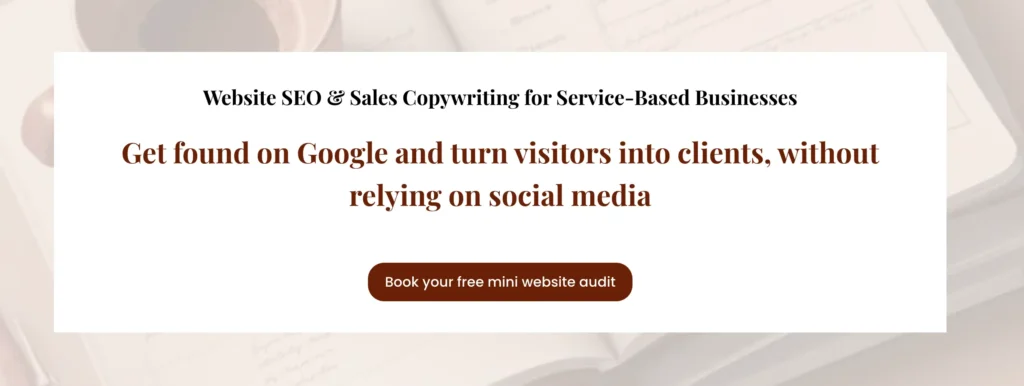
Your first section (called “hero section”) should immediately answer what I call the 4-W Questions:
- Who you help,
- What you help them achieve,
- Why you’re the obvious choice.
- What to do next (the call-to-acction button)
Here’s my homepage hero section, for example.
3. SEO that brings people in while you sleep
SEO (Search Engine Optimization) is the difference between having a shop at the end of a one-way street in a small village and having a shop on the main street in a big town.
When you show up for the keywords your ideal clients search, your website becomes a lead magnet on repeat. It works for you 24/7, whether you walk your dog, go on holiday or work with your existing clients.
4. Visual hierarchy and structure
People read websites like they read cereal boxes (if they’re not gluten intolerant)… Fast.
Your structure needs to guide their eyes straight to the information that makes them trust you: big headlines, smaller sub-headlines, body font 16 to 18px
5. Proof that makes you trustworthy
You need to display testimonials, results and proof of your expertise. People buy what feels safe, evidence is needed on your website.
If you want to learn how to collect testimonials that actually build trust (not just “great service, super professional”), I’ve created a resource for that. I’m covering this inside my program Sold Out SEO that teaches you how to get your website found and write words that sell your offers like hot croissants.
Here’s what my client, Elyse (lead singer of Eurodance group MAXX since 1994, Songwriter, Digital Sound Expert), said:
“Morgane turned my website and content into client-attracting powerhouses, so I can focus on what I love.“
6. Buttons that move prospects forward
Weak button texts (also called call to action, CTA for short) don’t make them excited or see why they should click.
Good calls to action tell your visitors the next step they need to take to get closer to their desired results. It reassures them and encourages them to take action, while building trust.
How to fix your website to get more sales
If you want your website to start doing the selling (and I know you do… who wouldn’t, right?), here’s the fix:
1. Rewrite your homepage clearly, using words your clients use
- Lead with the problem you solve and for who.
- State what you do in simple language (no expert talk, your clients don’t know anything about the technical side of your expertise).
- Avoid “airy-fairy words” or broad terms (including buzz words) that sound nice but mean nothing. Like “unlock your mindset for change your life”, this is too vague.
2. Add persuasive messaging across key pages
- Homepage.
- About.
- Services.
These three pages need copy that positions you as the obvious choice.
Persuasive messaging takes into account the buyer’s journey. Your visitors need to feel understood and seen, to see you have the solution to their problems and also that it’s accessible to them.
Persuasive writing is also about anticipating objections. Everyone has doubts and their own “yes, but”… The key is to answer these “yes but” before they even voice it.
- But here’s what persuasive writing is NOT:
- Manipulation
- Playing on fears (like fear of missing out)
- Guilt-tripping
- Shaming or making people feel bad if they don’t take action
- Making promises that aren’t realistic (or legal!)
I firmly stand against all of the above and dodgy marketing strategies (like the famous “bro marketing”).
3. Do proper SEO to bring in qualified traffic
Here’s the secret recipe:
- Keyword research (Learn how to do that without any paid tool here: How to choose keywords for SEO with free tools
- Search intent: people who have an urgent problem to solve will type different keywords from people who are not really aware of the true nature of their problem, let alone the solution they need to solve it.
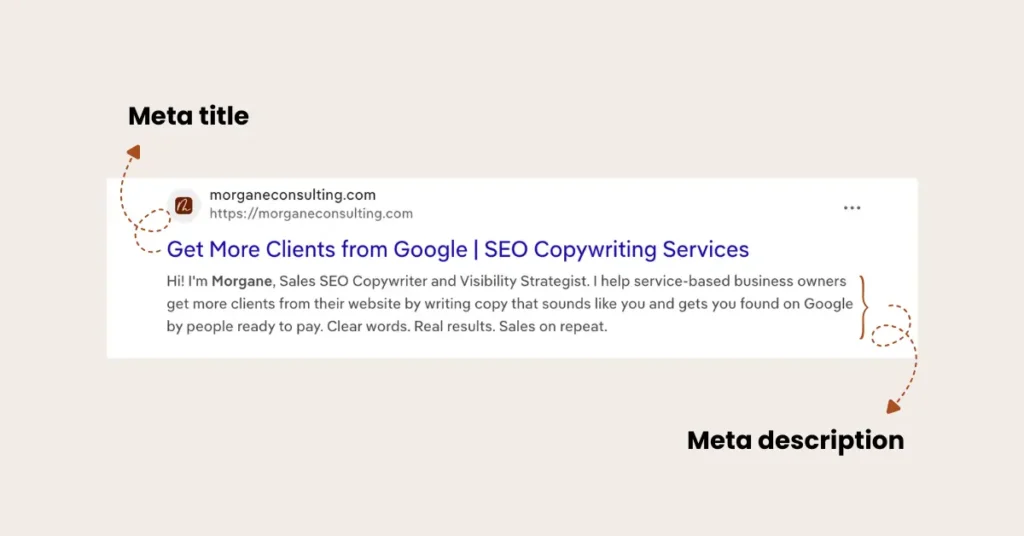
- Optimised meta titles and descriptions: what shows up on Google search results. These are the fields you see when you write your website pages, these are important for your website to communicate with Google, so to speak. (see image below)
- Headers that Google understands: Google needs to have the right signal to understand which sentence is your title, your subtitle and your main text.
- Blogs that answer real questions. Blogs build trust and if you want them to turn readers into clients, you need to create awareness of your visitors’ problem, make them feel seen, show the solution to their problem and also show YOUR solution.
This is how strangers become prospects on autopilot, and then clients.
4. Strengthen every call to action
Tell them what to do and why it matters. Make the next step easy and appealing.
Instead of “Learn More”, you can say “discover how to (solve XYZ problem)”
5. Build trust on every page
Here are the elements you need to add:
- Testimonials – those that sell and speak for you (not generic, as seen above)
- Client wins, aka case studies
- Elements that show your authority and expertise (for example: logos of clients, features, podcasts, clear methodology or proprietary framework…)
- In other words, you turn your website into your best sales person when you add proof that you’re not “just another service provider”, but you’re THE obvious choice.

When to get expert help
If you’ve tried fixing your website yourself and nothing changed, it’s not you. Websites need strategy, and strategy is what you learn inside Sold Out SEO.
Sold Out SEO is my 6-month program with live support. When you join, you learn how to write copy that converts, optimize your site so Google finds you, and build a complete visibility system that brings clients without you having to constantly create content.
You’ll have a straight roadmap to turn your website into a client generator, without fluffy theory, only practical teachings with implementation and support in the community + during live calls.
Let’s get your website on Google’s 1st page,
Morgane


FAQ – Why your website isn’t bringing clients
Why does my website look good but still get no clients?
Because design doesn’t sell. Messaging, structure, SEO, and CTAs do.
Do I need SEO if I have a nice website?
Absolutely. Having a website that’s not optimized for search engines is like having a Ferrari that stays in the garage because you don’t have a driver’s license… it’s just… sitting there looking nice. Without SEO, no one finds you. No visibility, no prospects, no clients.
How long does it take to see results once I fix things?
Messaging changes can increase your sales immediately.
SEO results can take a few weeks to a few months depending on the status of your website before its optimization.
One of my clients started seeing +19% of visitors in the first 20 days. Elyse has gained 20k+ views in about 5 months with her weekly blogs once her website had been totally revamped and optimized.
Should I rewrite my website myself or hire a pro?
If clarity and selling are your strengths, go for it.
If not, hiring an expert saves you months of frustration. Make sure the copywriter your hire does both sales copywriting and SEO optimization (like yours truly). If you prefer a done-for you service, check out my Website Optimization service.
Blog updated in February 2026
Book your free mini-website audit | Explore Sold Out SEO | Blog Menu | Homepage