You post, engage, comment… You show up daily (or at least several times per week) on Instagram or LinkedIn. And still, getting clients feels harder than it should, while marketing tasks should definitely not take that much time.
Here’s why: you’re using a marketing strategy that only works when you’re actively working on it. Social media demands constant presence. Your website and blog? They work 24/7.
On a late Friday afternoon, I was on my treadmill taking a break. Showered, came back to my desk, and saw a booking notification from a vet who wanted a website audit. The following Sunday night at 11:02pm, right before bed, a 6-figure business owner booked an audit too.
I wasn’t posting stories, I wasn’t “engaging in the comments”, and I was definitely not filming a night time skin care routine Reel to please the algorithm (I’m not an influencer and my clients couldn’t care less about that, that’s irrelevant).
My website was doing the selling while I lived my life.
That’s the difference between exhausting marketing and relevant marketing that works for you.
In this article, I’ll show you another strategy that gives you space to breathe. We’ll cover:
- Why social media marketing feels like a grind
- From stranger to buyer: How people really decide to become your clients
- What a website and blog actually do for you
- What a simple marketing system looks like
- How to simplify your marketing + FAQ
TL;DR
Social media only works when you’re actively working it. Posts disappear in hours and you start over tomorrow. Your website and blog show up on Google when people are actually searching for solutions. They filter visitors, answer objections, and guide buyers forward without you repeating yourself. One well-written blog post attracts clients for years while social content dies by morning. If marketing feels exhausting, you’re relying on a system that demands constant presence instead of one that works while you sleep.
Why social media marketing feels like a grind
Most service businesses rely on marketing that only works when actively present, and that’s actually what social media is about.
Social media isn’t bad. It’s just designed for one thing: keeping people scrolling, not finding an expert that can solve their problem.
Yes, it’s presented as a quick-win marketing, where instant results are usually “sold”. But the truth is that social media marketing is not only about posting randomly. It requires a strategy that not everyone (and their nervous system) is built for.
When someone needs a lawyer for their divorce, they don’t scroll Instagram hoping to find one. When a pet owner needs a vet for their puppy’s vaccinations, they Google “puppy vaccination vet (city name).”
They’re not looking for your breakfast photo or your “5 tips” carousel, and they definitely won’t choose you because you eat the same cereals… “OMG twins! I need to work with them” No… Not in real life.
People want clarity on their problem and the confidence that you can solve it.
Social media posts expire fast, they get buried in hours. Every reel, every thread, every carousel disappears (even if you’ve written the best post ever). You start over tomorrow.
There’s a huge confusion on social media between the entrepreneur business model and the influencer business model that requires constant attention. And if you’re like me, you have NO desire to be an influencer.
So yeah… creating content, engaging, commenting under random people’s posts hoping they comment back (and even if they do, it doesn’t mean they’ll become your clients). That’s a huge time investment that doesn’t guarantee any return on investment.
Whereas a well-optimized blog post can bring in clients for years.

From stranger to buyer: How people decide to become your clients
Here’s what social media coaches won’t tell you: most buyers aren’t looking for posts or social media updates when they need an expert.
Many people go on social media for entertainment or to look around, especially on platforms like Instagram, Facebook, TikTok and X (formerly Twitter). They scroll when sitting on the toilet or to pass time when they’re bored, on the bus or taking a break.
They are looking for someone who can clarify their problem, provide a real solution (not a bunch of fluff) and guide them forward to finally solve that said problem.
They don’t only want someone who “gets them”, they want someone who explains:
- What’s actually happening
- Why what they’ve tried hasn’t worked
- What they can do next and why it will work for them.
A marketing strategy for a service business needs to reflect this reality. Your goal isn’t constant attention, it’s clarity and guidance.
When they see your post, they’re not necessarily in the mood for buying, they see it “accidentally”. They don’t really interact and when your posts are seen by the wrong people who don’t stop the scroll, your post dies to never be found again.
Your hard work is wasted.
People don’t buy because you posted three times today. They buy because you gave them clarity when they needed it the most.
Here’s the real buying journey:
- They identify a problem (urgent or growing)
- They search for answers (Google, not Instagram)
- They filter options based on who explains things clearly
- They choose the expert who shows them the obvious next step
Example: A business owner searches “why general terms and conditions are necessary lawyer.” They find your blog post that explains what happens without solid terms and conditions, why generic templates fail, and what working with you looks like. They book a call because your content already built trust.
Your website and blog meet people exactly where they are when they are actively looking for solutions.

What a website and blog actually do for you
A website and blog, when optimized, become long-term visibility assets.
Here’s what they should do:
- Filter visitors fast. Your homepage should make it obvious who you work with, wrong-fit people leave, right-fit people keep reading.
- Answer objections before they ask. Blog posts and service pages handle the “yes, but what if…” questions without you repeating yourself in every discovery call.
- Guide buyers step by step. From “I have this problem” to “I’m ready to book,” your content leads them forward without confusion.
- Work while you don’t. One well-written blog post can convert strangers into clients for months or years: you publish it once, it keeps working.
I’d rather write one solid blog article that attracts clients for years than stress about whether today’s three posts will make anyone notice me.
One of my client’s website used to be buried on page 9 of Google. Meaning it wasn’t showing up when someone would look for her expertise. We optimized her homepage and services pages. We also wrote 6 blog posts answering her clients’ most common questions. Three months later, she’s ranking on page one for 16 pages of her website.
What this looks like more concretely
Let’s get specific.
❌ Bad homepage copy: “I help businesses grow and thrive by creating custom solutions tailored to their unique needs.”
Translation: I have no idea what you actually do.
✅ Good homepage copy: “Website copywriting and SEO for service-based businesses who want more qualified clients without spending hours on social media. If your site isn’t bringing in clients, let’s fix that.”
See the difference? One is vague, one is clear.
❌ Bad blog post title: “5 Tips to improve your marketing”
✅ Good blog post title: “Why your therapy practice isn’t getting referrals (And how to fix it without paid ads)”
The second one targets a real problem and promises a specific solution.
What you actually need for a marketing system that works for you
Stop adding more platforms, stop posting more often, start building a system that works for you, without you.
That system includes:
- A homepage that filters and qualifies. Wrong people leave fast. Right people know they’re in the right place.
- Service pages that remove objections. Answer the “why you, why now, why this price” questions clearly.
- Blog posts that show up on Google. Write for the questions your ideal clients are already searching for.
- Clear calls to action. Every page should tell people exactly what to do next (book a call, download a guide, whatever makes sense).
This isn’t about “posting more” or “showing up consistently.” It’s about making your website do the pre-selling so you can focus on serving clients, not hunting for them.
If your marketing feels harder than it should
You’re not bad at it, you’re simply using a strategy that demands constant effort instead of working for you.
Inside Sold Out SEO, my 6-month program with live support, you’ll learn how to build a marketing system that works while you sleep. You’ll learn website optimization, blog strategy, SEO implementation, copy that sells and the support to make it all happen without burning out.
I’ll see you soon,
Morgane

FAQ – Marketing that finally feels right
How long does it take for a website and blog to start attracting clients?
Usually, you see the first meaningful traffic in a few weeks, and the posts keep working for months or even years if structured properly.
The key is consistency in publishing and making sure each post answers real client questions.
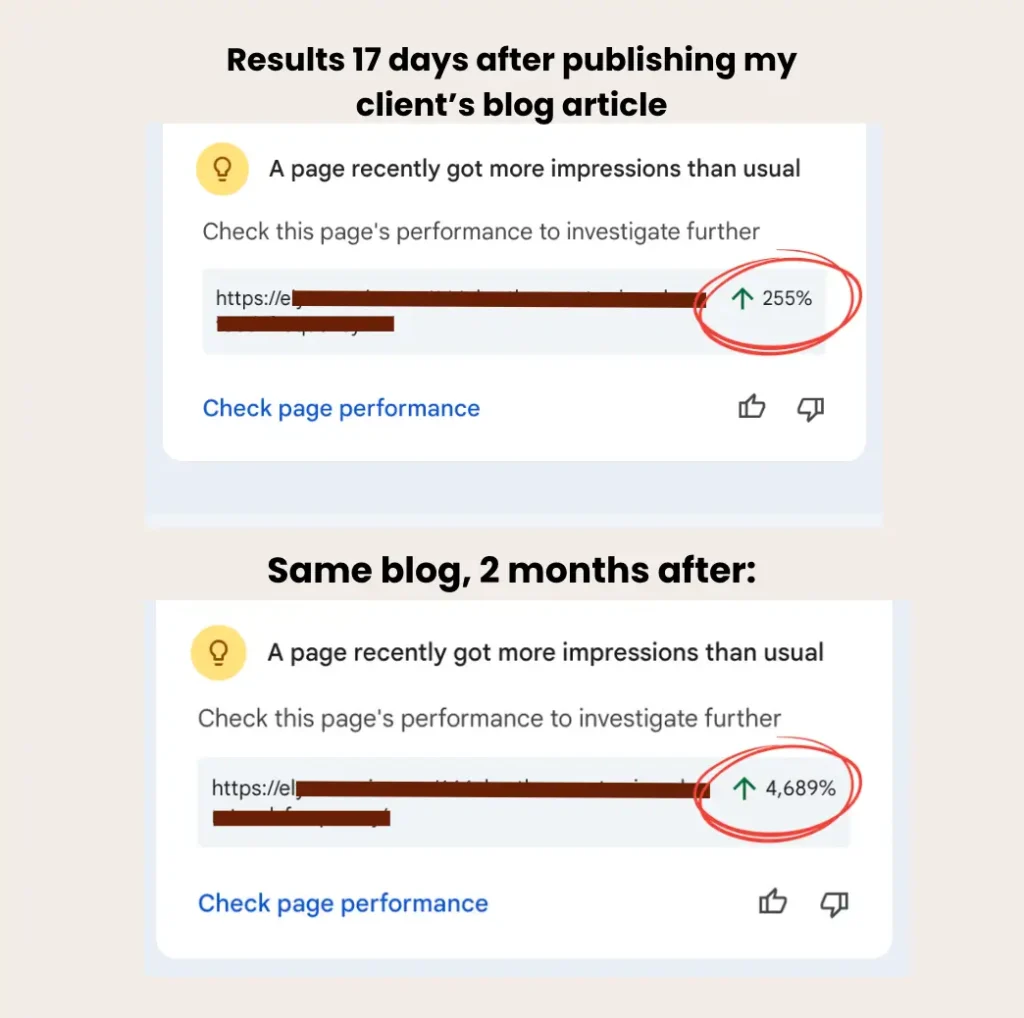
On the right, you can see one of my client’s results with one of her blog posts.
Do I need to post on social media at all if I have a strong website and blog?
You don’t need to post constantly. The choice is yours. 2 of my clients are rarely posting (one isn’t at all and one posts like twice a year). Social media can still support your visibility, but the heavy lifting (clarifying your services, filtering prospects, building trust) is done by your website and blog. Think of social as an optional amplification, not the core system.
How do I know if my current website is working for me?
If most of your time is spent explaining the same things repeatedly, you have few contact form requests and you can’t find yourself on Google when typing your service + town, your site probably isn’t doing enough.
Can I do this myself or should I hire you?
It depends on your skills, time, and patience. You can learn to structure content and optimize your website (which is exactly what I teach inside Sold Out SEO), but many service business owners save months of trial and error by having a professional handle blog copywriting and website optimization.
What types of blog content work best for attracting clients?
Content that addresses real client problems, explains the cause of their struggles, and shows a clear path forward. Case studies, FAQs, and how-to guides written in plain language usually perform best because they combine clarity, authority, and practical advice.
Book your free strategy call here to talk about a marketing strategy that fits your business and schedule.
Related articles you may want to read:
Updated in February 2026