You’re a damn good vet, you’ve saved lives, reassured anxious pet parents, and built a clinic that runs like clockwork.
But when someone in your area searches “vet near me” or “emergency vet (your city),” your clinic is nowhere to be found.
Meanwhile, the clinic down the street (the one that’s always overbooked and honestly not even as good as you) is sitting pretty on page one.
Why? Because they cracked the Google code. And you can too, you’ll learn how in this article.
Here’s the thing: being great at what you do doesn’t mean Google knows you exist. And if Google doesn’t know, neither do the people searching for a vet right this second.
Let’s fix that. Here’s what’s coming:
- Why Google isn’t showing your vet clinic (even though you’re excellent)
- What pet parents are actually typing into Google
- The 5 reasons your website is invisible right now and how to make Google notice your clinic (without paying for ads)
- What to put on your website so people pick you over the competition
- Real talk: why “just having a website” isn’t enough anymore
- FAQ
TL;DR
Your clinic isn’t showing up on Google because your website isn’t optimized for local search, your content doesn’t match what pet parents are searching for, and Google has no clue you’re the best option in town. Fix your local SEO, write for humans (not robots), and make it crystal clear why someone should choose you. Do that, and you’ll stop losing clients to competitors who aren’t even better than you.
Why Google isn’t showing your vet clinic (even though you’re excellent)
Imagine this: You run a small animal clinic in a mid-sized city, you’ve been practicing for 15 years, your clients adore you. You have a waiting room full of thank-you cards and a Google review average of 4.9 stars.
But when someone searches “vet + (your city)” you’re on page three.
Page. Three.
You know who goes as far as page three? No one.
The clinics on page one are getting the calls, the bookings, the new clients. And you’re sitting there wondering why your phone isn’t ringing like it used to.
The thing is that Google doesn’t care how good you are. To push you on page one, it cares about signals.
If your vet clinic isn’t showing up, it’s simply because your website isn’t doing its job. And that’s fixable.
What pet parents are actually typing into Google
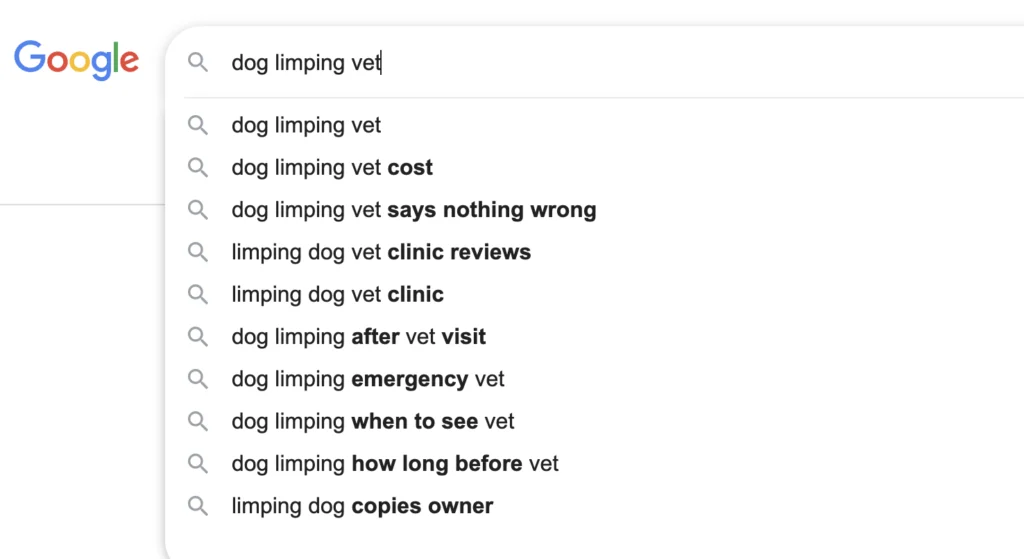
When someone’s dog is limping or their cat won’t eat, they’re not searching “holistic integrative veterinary wellness solutions.” They’re typing:
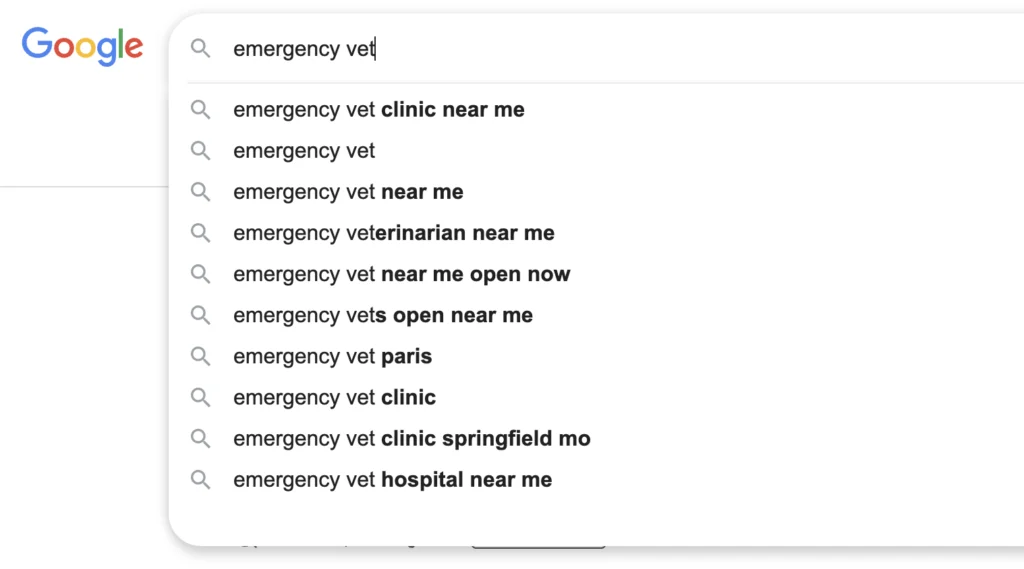
- “Vet near me”
- “Emergency vet open now”
- “Dog limping vet (city name)”
- “Cat not eating what to do”
- “Best vet in (neighborhood)”
- “Vet that takes new patients”
These are real searches happening in your area right now. And if your website doesn’t mention these exact things, Google isn’t connecting you to those searchers.
You need to speak the language of the person who’s panicking at 9 PM because their puppy ate a sock. Not the language you use with your peers.
Below, you can see Google’s suggestions. These are all potential keywords. If you want to learn how to find keywords, this blog article is exactly what you need: How to choose keywords for SEO with free tools
The 5 reasons your website is invisible right now and how to make Google notice your vet clinic (without paying for ads)
Let’s dig deeper, here’s why Google is ignoring you.
1. Your Google Business Profile is a ghost town
If you don’t have a Google Business Profile (formerly Google My Business), you’re losing hundreds of opportunities each month. And if you do have one but it’s incomplete, outdated, or never updated, same problem.
Google uses this profile to decide if you’re legit, where you’re located, and whether you’re a good match for someone’s search. If your profile says “on holiday” because you forgot to update it, or your address is wrong, or you have three photos from 2014, Google isn’t going to send anyone your way.
What to do about your Google Business Profile:
- Claim your profile if you haven’t already.
- Fill out every single field.
- Add your hours, services, photos of your clinic, and keep your info up-to-date.
- Post updates regularly (yes, really, it’ll bring more results than posting on social media).
- Respond to reviews (yes, even those that are unfair and negative) and remember to ask your clients to leave reviews.
Treat it like the free advertising tool it is, it’ll be rewarding.

2. Your website doesn’t mention your city or area in the right fields
You might think it’s obvious that you’re located in Austin or Brooklyn or Vancouver, because you wrote it in your address on your “Contact” page.
But Google is looking for clear signals in specific fields and places.
If your website doesn’t say “veterinary clinic in (your city)” in the main headlines and several times on your page (but still in a natural way), Google won’t connect you to local searches.
I’ve seen vet websites that say “providing quality care” but never once mention where they’re located. That’s like opening a restaurant, printing flyers to advertise, and forgetting to put the address.
What to do to improve the local discoverability of your vet practice:
Optimize every page of your website for local search. That means your homepage, your services pages, your about page. Include your city, your services, and the problems you solve. Write for humans, not for robots, but make sure the right words are there.
Mention your city, neighborhood, and nearby landmarks naturally throughout your site. In your headers, your service pages, your about section. Make it impossible for Google to miss, this simple tweak will bring you more visibility.
3. Your content is too broad (or nonexistent)
If your website is just a homepage that says “Welcome to (Clinic Name). We love animals and provide the best care”, Google has nothing to work with. There’s no depth, no answers, no reason to push you at the top of page one.
I know it sounds harsh, but I want you to be successful.
Google wants to send people to websites that will actually help them and provide solutions.
If someone searches “why is my dog scratching so much” and your competitor has a blog post about skin allergies in dogs, guess who Google is going to show?
What to do for your content to be relevant (both for humans and Google):
Write content that answers the questions your clients ask you every day, include these on your service page, add an FAQs. Make your website a resource, a living library, not a digital business card.
And of course, blog posts are super helpful, not only for people but for you also. They help you be seen as the go-to expert in town (and beyond).
Write blog posts about the things people search for. “What to do if your dog eats chocolate”, “How to know if your cat is sick”, “When to go to the emergency vet”. These posts bring traffic and position you as an authority who’s accessible.
It doesn’t have to take time, and if you need someone to write your content for you, I have a Blog Copywriting service with small business-friendly budgets: Expert Blogs that bring clients without social media.
Build local links: Get listed on local directories, partner with other local businesses (pet stores, groomers, shelters), sponsor community events. Every time another local site links to you, Google takes notice and your domain authority increases.
Side note: Just make sure you get on directories that have a good reputation, otherwise it could harm you more than help you. If a stranger approaches you out of the blue and offers to put your link onto their website for a fee, run away, Google doesn’t reward random linking.
4. Your website is slow, broken, or impossible to use on mobile
If your site takes 10 seconds to load or looks all over the place on a phone, Google will penalize you for it (even if it looks great on desktop).
Most people are searching on their phones. If your site is not responsive (meaning, if it doesn’t work on mobile), that’s a big problem.
What to do to improve your website responsiveness and speed:
Test your site on your phone right now and observe:
- Does it load fast?
- Can you click buttons without zooming in? Your uncle Bob who’s 6 feet 3 in and therefore has big thumbs should be able to click with ease.
- Is the text readable? There are 3 aspects to legibility:
1) Your font size should be big enough (recommended sizes: 16 to 18px – I use 17px)
2) The font type should also be easy to read (fancy fonts are cute but what’s the point if no one can read them and they’re not loading on all devices?)
3) The color contrast needs to be easy on the eyes, especially for visually impaired people. Google penalizes bad contrasts. You can check the contrast with a free tool call Coolors
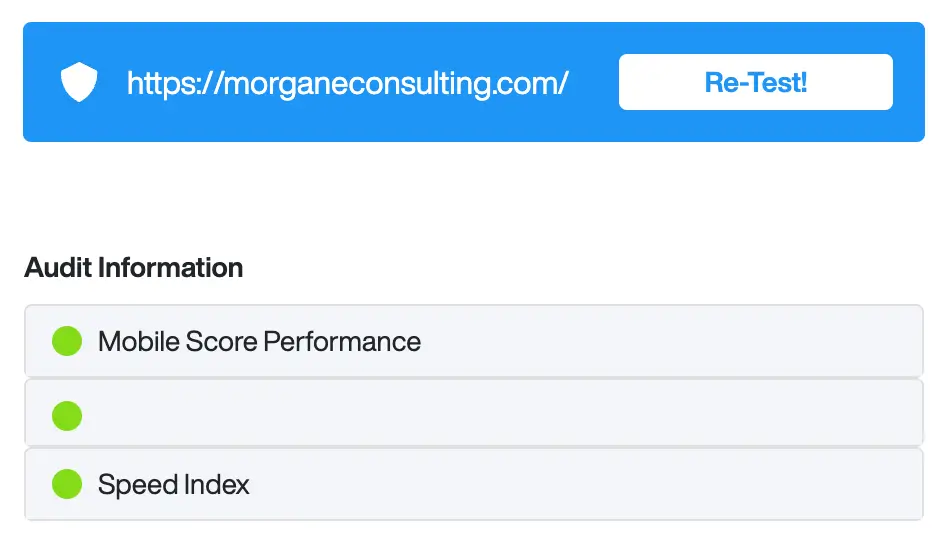
If you answered no to one or more questions, I recommend fixing this ASAP. Google has tools (like PageSpeed Insights) that’ll tell you what’s wrong. You can also test your mobile responsiveness with a Google Chrome Extension.
Not sure where to start? Book your free mini website audit for vet clinics and I’ll show you exactly what’s keeping you off page one.
5. You have zero reviews (or you’re ignoring the ones you have)
Reviews are social proof and they’re a search engine optimization (SEO) signal. If you have 3 reviews and your competitor has 150, guess who looks more trustworthy to Google and to potential clients?
And if you’re not responding to reviews (especially the bad ones), you’re missing a chance to show you care and to keep your profile active.
What to do to have more reviews:
Ask happy clients to leave reviews. Make it easy for them (send them a direct link to your Google My Business page).
Respond to every review, good or bad, Google notices when you engage. And make sure to include keywords in your answers.
Ex: Thanks for trusting our veterinary practice, it was a pleasure to take care of your dog.
You don’t need a massive budget or a marketing degree. You just need to be strategic.

What to put on your website so people pick you as their vet over your competitors
Let’s say Google does start showing your clinic. Now what? You need to make sure people actually click on your site and then book with you.
Your website needs to do three things:
1. Make it obvious what you do and where you are, don’t make people hunt for this. Your homepage should say “Full-service veterinary clinic in (City)” right at the top.
2. Show them why you’re different. What makes your clinic special? Do you have extended hours? A fear-free certification? A vet who specializes in reptiles, birds or farm animals? Say it loud and clear.
3. Make it super easy to book. Your phone number should be accessible from every page, so should a “Book an Appointment” button. If someone has to dig through three pages to figure out how to contact you, they’re going to your competitor instead.
Here’s the secret: people don’t choose the best vet. They choose the vet who makes them feel like they’re in good hands, fast. Your website should do that in 5 seconds.

Real talk: why “just having a website” isn’t enough anymore
Ten years ago, having a website was enough. Now? Every clinic has a website. The ones who are winning are the ones whose websites actually work.
That means your site needs to:
- Show up on Google (so people find you)
- Build trust (so people believe you)
- Convert visitors into clients (so they book)
If your website is just sitting there looking pretty but not bringing in new clients, it’s not doing its job. And you’re leaving money on the table.
The good news? You don’t have to figure this out alone.
Your website should work as hard as you do
You didn’t go to vet school to become a marketing expert. You went to save animals and help worried pet parents sleep at night. But if your website isn’t bringing in new clients, you’re stuck doing all the heavy lifting.
Your website should be your best employee. It should show up on Google, answer questions, build trust, and book appointments while you’re busy doing what you do best.
If your clinic isn’t showing up online and you’re tired of losing clients to competitors who aren’t even as good as you, let’s fix it.
Book your free mini website audit for vet clinics. I’ll review your site, your Google Business Profile, and show you exactly what’s blocking your visibility and how to fix it.
This is not a sales pitch, you’ll get clear feedback you can use whether you hire me or not.
Book your free vet clinic website audit here.
Your turn, go make it happen and let me know how it goes.
Morgane


FAQ – Why your veterinary clinic isn’t showing up on Google
How long does it take to appear on Google?
It depends on how much work your site needs, but most clinics start seeing movement in 1 month. Local SEO is faster than trying to rank nationally or internationally, so you’ve got that going for you. The key is consistency, at least at the beginning. You can’t optimize your site once and walk away forever. Google rewards sites that stay active and relevant.
Do I need to pay for Google Ads to show up?
Nope. Google Ads can get you to the top fast, but they’re expensive and the second you stop paying, you disappear. Organic SEO (the free kind) takes longer but it’s sustainable. Once you are indexed by Google, you keep getting traffic without paying for every click. That said, combining both strategies can work if you have the budget and want fast results while your organic rankings build.
What if I’m in a small town with not much competition?
Even better! Small towns are easier to rank in because there’s less competition. You can dominate local search with a solid Google Business Profile, a well-optimized website, and consistent content. Don’t assume people will just find you because you’re the only clinic in town. They’re still searching online and you want to be the obvious choice when they do.
Can I do this myself or do I need to hire someone?
You can absolutely do some of this yourself. The Google Business Profile stuff, asking for reviews, writing blog posts, all doable. But if your site needs technical SEO fixes (speed, mobile optimization…) or if you don’t have time to write content consistently, hiring someone who knows SEO and copywriting will get you results faster. Think of it like this: you could learn to fix your own car, but it’s usually smarter, easier and faster to pay a mechanic.
What’s the difference between SEO and Google Ads?
SEO is the work you do to appear organically (for free) in Google’s search results. It takes time but it’s sustainable. Google Ads is paying to show up at the top of search results. It’s fast but it costs money every time someone clicks. Most businesses do best with a mix of both, but I don’t recommend paying for Google Ads, especially if you’re just starting out. Focus on SEO first, it’s a better long-term investment (and investment implies return on investment).
How do I know if my website is optimized for mobile?
Pull out your phone right now and open your website.
- Does it load in under 3 seconds?
- Are the elements looking good or all jumbled?
- Can you read the text without zooming in?
- Are the buttons easy to click?
- Can you find your phone number and book an appointment without scrolling forever?
If the answer to any of these is no, your site isn’t optimized. You can also use Google’s Mobile-Friendly Test tool (just search for it) to see how your site scores. If you’re unsure, send me a DM on LinkedIn or Facebook and I can test it for you at no cost.
What if I already have a website but it’s not bringing in clients?
Then your website exists, but it’s not working. It’s probably missing key SEO elements, clear messaging, or a strong call to action. Most vet clinic websites are gorgeous but say nothing useful. They don’t show up on the 1st page of Google, they don’t build trust, and they don’t turn visitors into clients. The fix usually involves rewriting your copy (or at least your headlines) to speak directly to your ideal client, optimizing for local search, and making it super easy for people to take the next step.
Book your free mini website audit and I’ll show you exactly what’s stopping your site from bringing in new clients.