Quick answer
SEO results can show up as early as the first one to two months if your domain has been around for over a year and you have a solid strategy in place. Brand new sites (under 6 months old) usually take 3 to 6 months because Google needs time to trust them first. The first signs of progress, like more impressions and a few clicks, often appear within the first 3 weeks. But the real momentum, the kind where clients start finding you consistently, typically happens between months 3 and 12. The biggest mistake is quitting after 2 months.
You’ve had a website for months, maybe years. You might have added some keywords here and there, published a couple of blog posts, maybe even paid someone to “do the SEO”. And yet, when someone Googles what you do, your site is nowhere to be found, or shows up on page four, where no one ever goes.
So now you’re wondering: how long is this actually supposed to take? Is SEO even worth it? Or are you just throwing time and money into a black hole?
Here’s what’s in this post:
- How long SEO realistically takes (with real numbers from real clients)
- The 5 factors that decide how fast your site gets found (aka how fast your SEO works)
- What speeds up your SEO (and what quietly kills it)
- The early signs your SEO is working (before you hit page one)
- Ready to see results with SEO? When to get help and what to do next
- FAQ

How long SEO realistically takes (with real numbers from real clients)
Everyone wants a precise number, and I get it, you’re running a business, you need to plan.
So here’s the realistic range most SEO professionals agree on: 3 to 6 months to see meaningful improvement in rankings and organic traffic.
But that range can shift quite a bit depending on where you’re starting from.
Here’s what the timeline typically looks like in practice from my experience:
- Weeks 1 to 4: Google starts crawling and indexing your pages. You might notice your impressions (the number of times your site appears in search results) start ticking up in Google Search Console. Don’t expect a flood of visitors yet if your domain name is brand new. If it’s is over one year old, you might see more visitors but still not to the full potential yet.
- Weeks 4 to 8: If your domain has been around for more than a year, you may start seeing a handful of new clicks/visitors, more impressions and more inquiries. Small wins that definitely count. For newer sites, it’s still mostly Google watching and building trust.
- Months 3 to 6: This is where things actually start moving. Pages start showing up in search results, traffic picks up, and you begin seeing prospects and even clients arrive through Google searches if your domain name is over one year old. I got my first booking from Google when my domain name was 6 months old, someone found my blog and booked straight away.
- Months 6 to 12: The snowball is rolling. Older blog posts and pages keep generating more and more traffic, new content gets indexed and shows up in search results much faster. Your website starts working like the client-getting machine it was always supposed to be.
To summarize: the older your domain name is, the faster you’ll see results, aka more visitors that turn into clients.
Why does it take months?
Because Google has over 200 ranking signals to evaluate, and it doesn’t hand out first-page spots to sites it barely knows. It watches how people interact with your content, if your site is technically solid, and if other credible sites link to yours. And that takes time.
One thing I do for my clients to speed things up: I manually submit new pages to Google Search Console so Google checks them sooner rather than later.
If you want to see what needs to be fixed on your website because you go all in on SEO, you can book your free 1:1 mini audit.
You’ll walk away knowing exactly what to prioritize so you can either fix it yourself, learn with me inside my Sold Out SEO Academy™ or let me handle it for you.
Your choice, no strings attached.

The 5 factors that decide how fast your site gets found (aka how fast your SEO works)
Not every website starts from the same place, and that’s why some see results in 4 weeks and others need 6 months. Here’s what makes the difference.
1) How old your domain is
Studies show that the majority of Google’s top results are pages that have been around for nearly three years. If your domain is over a year old, you already have a solid start because Google trusts established sites more than brand new ones.
If your site is under 6 months old, you’re in what I call the “probation period”, meaning Google is watching you with a little skepticism, while still giving you the benefit of the doubt.
Results take longer, but they absolutely come if you stay consistent.
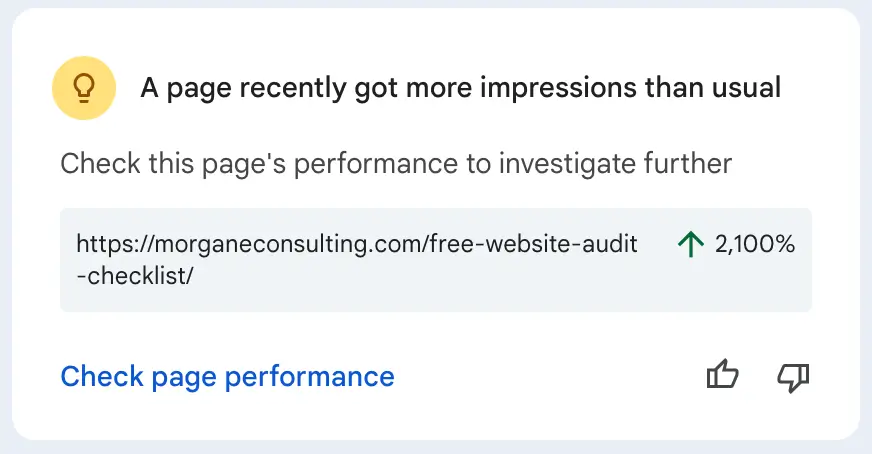
Here’s something from my own experience: when I launched a free PDF resource, my domain was about a month old.
But because I optimized the page properly with the right keywords, I started seeing results about one month after publishing, so roughly 2 months after the domain was created, as the image below shows. You can see a 2100% increase in impression.
2) How competitive your industry is
If you’re a therapist in a small town with a handful of competitors, you can show up in 1 to 2 months. If you’re an employment lawyer in London competing with firms that have been optimizing their sites for a decade, expect 3 to 6 months minimum.
Less competitive niches move faster, high-competition industries need more patience and a smarter strategy.
3) The quality of your content and optimization
One excellent, well-optimized blog article will always outperform ten mediocre ones. Publishing something just to have content out there is not a strategy.
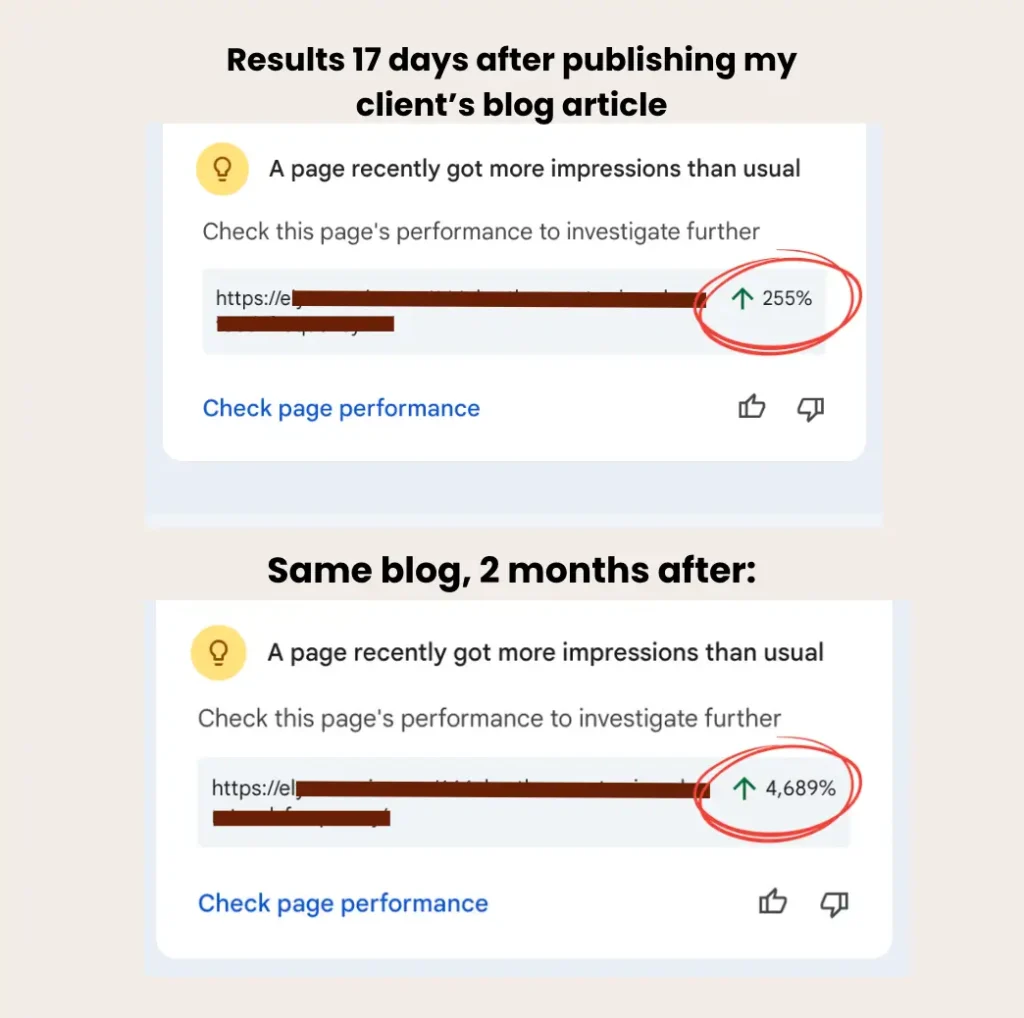
One of my clients, an online course creator, publishes one blog article per week (I handle her content optimization).
Here’s her results after 6 months:
- Her site had 39 pages on Google’s first page out of 49 total.
- One of her blog posts went from zero to over 4,600 impressions in 2 months and is still one of her most visited pages to this day.
A quick note on AI-generated content
I say this to all my clients: there’s no point in publishing a generic AI-generated blog article for the sake of getting content out there. You might as well not publish anything or you’ll shoot yourself in the foot. Even more so if your domain is brand new.
If it has no personality, no real insight, no depth and no specific detail that only you could add, Google won’t push it forward in search results and your readers won’t trust it.
Add your own stories, examples, and voice. That’s what makes content trustworthy and converts visitors into clients.
4) The technical aspect of your site
A slow, poorly structured, mobile-unfriendly site with hidden technical errors will make Google “run away” from you. A clean, fast, mobile-optimized site gets indexed faster and gets better results sooner.
This is one of the first things I look at with any client. Technical issues are often invisible to the naked eye but very visible to Google.
Book your free mini website audit today, I’ll let you know if you have any technical issues and what to fix.
5) Your SEO history
If your site has been hit with Google penalties in the past, or someone ran shady SEO tactics on it before, you’ll need to re-gain Google’s trust. Recovery can sometimes take longer than starting afresh, but it’s doable, especially if you know exactly what to fix.
If you’re starting fresh with a solid foundation, you’ll see results sooner.
What speeds up your SEO (and what quietly kills it)
Here’s what actually moves the needle forward:
- Publishing consistently: That same online course creator client went from 6,000 monthly impressions to 43,000 in 7 months with one article a week. It’s now month 10 and she’s at 79k impressions. Consistency generates the snowball effect that one-off publishing never will. One article a month will still get results, just slower, you choose your pace.
- Optimizing for local search: If you have a physical location or serve a specific area, local SEO is your fastest track. A Google Business Profile, regular client reviews, and your city mentioned naturally on your site can get results in 1 to 2 months. One of my clients, a vet practice, saw a 150% increase in calls and a 77% increase in site visitors in 2 months without a single blog post, just local SEO.
- Targeting long-tail keywords: Instead of trying to target “therapist” (very competitive), target “therapist for anxiety in (your city)” or “couples therapist specializing in divorce.” Long-tail keywords bring in fewer visitors but qualified ones, and they get your website found faster, sometimes within a month.
- Fixing technical issues before publishing new content: A fast, clean, error-free site gets indexed properly. Do the technical work first so every piece of content you publish has a chance to work for you as soon as you publish it.
What slows your progress down (or stops it entirely)
- Stopping at the 2-month mark: This is the most expensive mistake you can make in SEO. The content you publish today will bring you traffic in 3, 6, or 12 months and beyond. Quitting before you see results means you never see the results.
- Publishing low-quality content just to tick a task on your to-do list: One thorough article a month beats four forgettable ones. One rule: quality over volume.
- Ignoring mobile optimization: Google uses mobile-first indexing, which means it evaluates your mobile site first. If your site is broken or clunky on a phone, your business will suffer for it.
- Not using Google Search Console: If you’re not tracking what’s happening on your site, you’re optimizing blind. Search Console shows you what’s working, what people are searching to find you, and where the gaps are.

The early signs your SEO is working (before you hit page one)
You don’t have to wait 6 months to know you’re on the right track. Here’s what to watch for.
- Impressions climbing in the Google Search Console: This means Google is starting to show your pages in results, even if you’re not on page one yet. More impressions over time means Google is paying more attention to your site.
- You’re getting a few clicks: Even 2 or 3 clicks a week is a signal that your content is starting to show up for real searches. Those small numbers grow.
- You’re showing up on page 2 or 3: Not page one yet, but you’re in the game. Google is testing your content, if people click and stay, you keep climbing.
- Someone contacts you and says they found you on Google: Even one inquiry a week from someone who found you organically is the system starting to work. That’s not luck, that’s your site doing its job, get used to it 😉.
Ready to see results with SEO? When to get help and what to do next
If your site has been live for more than 6 months and you’re still not getting clients from Google, something in your strategy or your website optimization needs to change.
That’s exactly what I look at in my free mini website audit.
I review your site and your Google presence before we get on the call. Then we spend 20 minutes going over exactly what’s holding you back, whether it’s vague copy, missing SEO, a confusing layout, or all of the above.
You’ll walk away knowing:
- What’s stopping your website from bringing in more clients
- Which fixes will have the biggest impact on getting you found and chosen
- A clear picture of what your site actually needs (no generic advice, no cookie-cutter recommendations)
This is a real audit with real feedback, even if we don’t work together after, you’ll know exactly what to fix.
No charge, no pressure, just clarity.
Book your free website audit here.
If you want to go further and learn the full system, that’s what Sold Out SEO is for.
It’s a 6-month self-paced program with support and accountability where you learn how to make your website easy to find on Google, write copy that turns visitors into actual clients, and build a visibility system that keeps working whether you post on social media or not.
You get the training, live weekly group calls, direct feedback on your website and content within 48 hours maximum, and a private community so you’re never stuck figuring it out alone.
No overnight results (because let’s be honest, these don’t exist). But if you show up and do the work, your website becomes your most reliable client source that brings in clients while you sleep, take the week off, or live your actual life.

FAQ: How long does SEO take to work?
The SEO principles are the same whether you’re on WordPress, Squarespace, Wix, Showit, or any other platform. What changes is how easy or complicated it is to implement certain technical optimizations and also the way platforms are built. Some platforms are more flexible than others, but the strategy itself, the keywords, the content, the structure, doesn’t change.
Yes, and here’s why: referrals are unpredictable. You can’t control when they come in, or whether they’ll keep coming. SEO gives you a stream of clients that doesn’t depend on someone else remembering to mention your name. When referrals slow down (and they always do at some point), your website is already working.
Paid ads can get you visibility fast, but the moment you stop paying, you disappear. SEO takes longer to build but keeps working without ongoing spend. A blog post you publish today can bring you clients two years from now. That’s the compounding effect that makes SEO worth the investment for service providers.
Search is changing, yes. But the fundamentals stay the same: create genuinely useful, specific content that answers real questions from real people. In fact, AI-generated summaries in search results often pull from well-optimized, authoritative content, which means good SEO matters more, not less. The sites that win are the ones that actually say something worth finding.
Not necessarily. A veterinary client of mine saw a 77% increase in site visitors and a 150% jump in calls in just 2 months with no blog at all, purely from optimizing the existing pages and local SEO. Blogging accelerates results and helps you get found for more searches over time, but it’s not the only path.
It depends on whether you do it yourself, hire someone to do it for you, or join a program where you learn to do it yourself. Done-for-you services typically run from a few hundred to several thousand euros per month. Learning the system yourself, like inside Sold Out SEO, is a fraction of that cost and means you own the skill and can apply it forever. It gives you the best ROI if you want to take the time to learn with support and accountability.
Backlinks (links from other websites to yours) help Google see your site as credible, but they’re not the only credibility factor. For local businesses or niche service providers, strong on-page optimization, a solid Google Business Profile, and quality content can get you found without an aggressive link-building strategy. It’s a factor, not the whole game.
Ready to turn your website into your most reliable client source?
If you’d rather get clarity on what your website needs first, book your free mini website audit here.
Related articles you may want to read next: