Social media is often presented as the obvious path to visibility, growth, and clients. You’ve probably heard all the advice: post consistently, engage daily, show up, be relatable, and eventually the algorithm will smile upon you.
That story sounds good and motivating, until you are the one staring at a content calendar, feeling drained, scattered, and wondering why something that is supposed to help your business feels like a second unpaid job.
Here is the part that rarely gets said out loud: social media is a powerful marketing tool, but it’s not a neutral one.
It doesn’t work the same way for every brain, every business model, or every stage of growth. For some business owners, it feels energizing. For others, it feels like constant noise. Both experiences are valid.
This article is not here to convince you to quit social media, nor to shame anyone who loves it. The goal is to give clarity around those different points:
- Social media is powerful, but also overwhelming and not for everyone (personally and strategically)
- The blurred line between influencer and entrepreneur business models
- How to choose a strategy that matches your business and your brain
- How you can build visibility without the posting hamster wheel
- FAQ
TL;DR
Social media favors speed, visibility, and personality-driven content. Expert businesses often need trust, clarity, and assets that compound over time. If social media feels draining or ineffective, it’s likely a strategic mismatch (and has nothing to do with “consistency). There are other ways to build visibility, authority, and sales without becoming an influencer.
Social media is powerful, but also overwhelming and not for everyone
Social media works brilliantly for some people, and this fact deserves to be acknowledged before anything else. One of my best friends is a social media genius, she’s having good results on it for herself and for her clients. So no doubt it works for some.
It can create momentum quickly, shorten the distance between the creator and their audience, and generate opportunities that would otherwise take years to unlock.
At the same time, it demands a specific type of output: frequent content creation, fast reactions, public visibility, and ongoing engagement… That’s how these platforms work.
For people who thrive on stimulation, rapid feedback loops, creative experimentation and the feeling they can “start over” every day, this can feel natural and even fun.
For others, especially people who think in systems, depth, and long-term strategy, that same environment can feel chaotic. (especially if you’re an introvert). The constant need to be present, visible, and responsive creates mental overload, lack of focus and doesn’t always translate into proportional business results.
This is not about willpower, consistency or motivation, it’s more about how different minds process work. If a marketing strategy doesn’t fit how your brain works, it won’t be sustainable, even if it looks effective on paper.
Why social media feels overwhelming for some business owners
One of the least discussed aspects of social media marketing is mental friction. Every platform requires decisions about what to post, how to say it, when to publish, how to respond, how to stay visible, and how to analyze metrics that change constantly.
For some brains, this is stimulating. For others, it creates low-grade stress that accumulates over time.
The issue is not posting itself, but the combination of visibility pressure, comparison, unpredictability, the feeling of being permanently on stage as well as the feeling of wasted effort. You spend time creating content that dies within hours.
When marketing drains more energy than it generates, it becomes an energy-sucking rabbit hole. Sustainable growth requires a strategy that supports your nervous system, not constantly challenges it.
Choosing a different way of doing marketing doesn’t mean you don’t want to grow. It simply means you’re choosing a structure that allows you to show up consistently without burning out.

Why social media is not a good strategy for some business owners
Beyond personal preference and personality, there are structural reasons why social media marketing doesn’t serve every business in the same way.
- Social media: attention over decision-making.
Content is optimized to keep people scrolling. Those platform don’t hide that fact that they want people to stay on their app for as long as possible (which is why sharing external links is now “punished”, a post with a link will simply now be shown to your audience).
They’re not built to make people evaluate complex offers or make thoughtful buying decisions.
This works well for low-friction products and personality-led brands, but it can be limiting for services that require trust and consideration.
- Short-lived content
Posts disappear quickly, reach fluctuates, and visibility often resets unless you keep producing. This means effort doesn’t always compound. You can work hard for months and still feel like you are starting from zero each week (or even each day).
It works for some, but for a brain like mine, it doesn’t make any sense to spend time on a piece of content that’s going to disappear.
- Visibility over clarity
Content that performs well is often content that sparks emotion, relatability, or entertainment. Many people scroll on social media when they’re bored, chilling, taking a break or… sitting on the “throne”… not really in a problem-solving-decision-making mindset.
Clear explanations, positioning, and educational depth are harder to surface, even though they are often what buyers need to make decisions.
None of this makes social media bad. It simply explains why some experts struggle to turn attention into clients, even when posts are getting likes. Likes don’t pay the bills.

The blurred line between influencer and entrepreneur business models
One of the biggest sources of confusion in online marketing is the blending of two very different business models: the influencer model and the entrepreneur model (that I also call the expert business model).
- Influencer business model
Influencer businesses are built on proximity. The audience buys access, lifestyle, personality, or identity. Trust is built through relatability and visibility, where the influencer is seen as a reference. It also gives a feeling of belonging to a community. (Even if some influencers behave in a way that’s very damaging to their community sometimes…)
- Expert business model
Expert businesses are built on outcomes. The audience buys solutions, processes, and results. Trust is built through clarity, proof, and demonstrated understanding of a problem.
Both models are valid but problems arise when service providers try to grow an expert business using influencer signals.
This is when content starts to feel performative, when oversharing replaces strategy, and when visibility does not translate into authority.
If you are selling expertise, your marketing needs to communicate reliability more than relatability. That does not mean becoming cold or distant, it means letting your work and thinking take center stage, rather than your lifestyle. You’ll still be relatable because you’ll not only be showing you understand people’s struggle, but you will also lead them out of it, offering a solution.
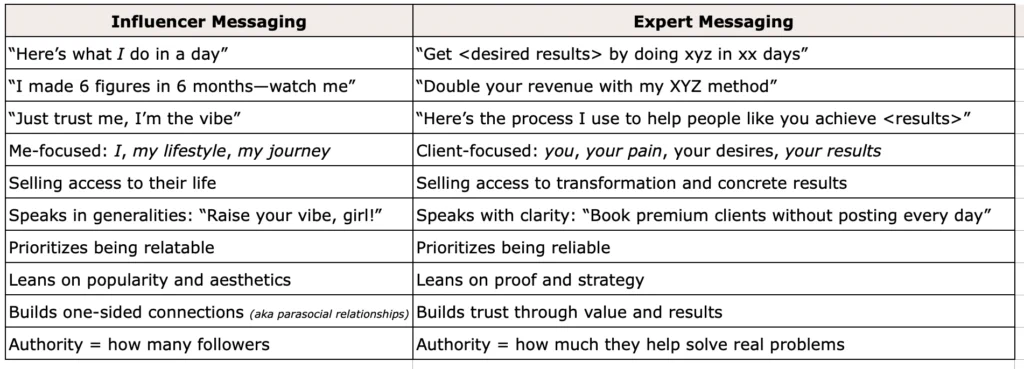
Relatability vs Reliability: two different types of marketing message
Relatability helps people feel connected. Reliability helps people feel safe making a decision.
Social media often rewards relatability because it drives engagement. Stories, personal struggles, and behind-the-scenes content humanize a brand and can build connection quickly. However, connection alone does not always lead to conversion, especially for high-trust services.
Personally, I don’t need to see my mechanic’s, my vet’s or my lawyer’s breakfast or what they did during the weekend to know if I want to work with them. And I know i’m not the only one.
Reliability is built through clear positioning, consistent messaging, and the ability to articulate problems and solutions with precision. It answers the unspoken question buyers have: can this person actually help me?
You can be human without turning your entire life into content. You can be approachable without making yourself the product (even if you have a personal brand).
Long-term authority grows when people associate your name with clarity and results, not just familiarity.
Here’s a comparison of the two different types of marketing message for each business model
How to choose a strategy that matches your business and your brain
Visibility that doesn’t require constant posting: intent vs interruption
One of the most damaging myths in online marketing is the idea that visibility must be earned daily through posting. In reality, visibility can be built through assets that work over time.
Search-based content, strategic blogs, clear website copy, and educational resources allow people to find you when they are already looking for help. This kind of visibility aligns with intent rather than interruption.
When your content is discoverable, it continues to bring in the right people long after it is published. That is a fundamentally different dynamic from content that disappears after a few hours or days.
For many businesses, especially service-based ones, this approach creates steadier leads, better-qualified inquiries, and less pressure to constantly perform online.
So, social media or long-term visibility marketing ?
Good marketing is not about doing what everyone else is doing. It is about choosing channels that match how you think, how you work, and how your buyers make decisions.
If social media energizes you, it can absolutely be part of your strategy. If it drains you, it should not be the foundation of your growth.
There is no moral value attached to platforms. They are tools, and the right tool depends on the job and the person using it; it’s as simple as that.
Building a business that lasts requires honesty about what is sustainable for you and effective for your audience. When those two align, marketing stops feeling like a constant push and starts feeling like a system.
How you can build visibility without the posting hamster wheel
If you want clients to find you without relying on constant social media posting, my Sold Out SEO™ program is designed exactly for that. It focuses on building long-term visibility through search, clear positioning, and content that compounds over time.
This is for service-based business owners who want authority, qualified leads, and growth without relying social media (and yes, it will work for you even if you’re not tech-savvy) and use platforms and content that work for you 24/7.
You can learn more about Sold Out SEO™ here and see if it fits your business.
If you have questions, you can book your free call, no strings attached.

FAQ: Visibility, social media, and alternative growth strategies
How do I know if social media is the wrong channel for my business?
If social media consistently feels draining, produces inconsistent leads, or takes more energy than it gives, it may not be the right primary channel. A mismatch often shows up as high effort with low conversion, even when engagement looks decent.
Can a business look legitimate without an active Instagram presence?
Absolutely. Legitimacy comes from clarity, proof, and consistency, not from platform choice. A well-positioned website, strong search visibility, and clear messaging often signal authority more effectively than frequent social posts. In Sold Out SEO™, I’ll also teach you how to optimize your social media presence, even if you don’t use it at all.
What type of businesses benefit most from non-social-media visibility strategies?
Service-based businesses, consultants, licensed professionals, and experts offering high-trust or high-consideration services often benefit most. Their buyers tend to research, compare, and seek reassurance before making a decision.
Is it risky to rely on SEO or long-form content instead of social media?
Every channel has risk. Social media relies on algorithms and constant output. Also, you don’t own your social media profile. if a bot logs you out or deletes your profile without any reason, you lose everything.
SEO relies on strategy, patience, and quality. The difference is that search-based assets tend to build up over time, while social content resets every day.
How long does it take to see results from a search-based visibility strategy?
Results vary based on competition, positioning, and execution. Most of my clients start seeing traction within one month, with stronger, more consistent results building over time as content compounds.
Do I need to be tech-savvy to use SEO effectively?
No. Good SEO today is less about technical tricks and more about understanding your audience, structuring content clearly, and answering real questions better than competitors.
Can I combine social media with a long-term visibility strategy?
Absolutely. Social media can support distribution and relationship-building while search-based assets handle discovery and lead qualification. The key is not making social media the sole engine of growth.
What is the biggest mistake businesses make when moving away from social media?
Abandoning visibility entirely instead of replacing it with their website, for example. Stepping back from social platforms should be paired with a clear alternative, such as SEO, partnerships, or owned content.
If you are rethinking your visibility strategy and want something that feels sustainable, clear, and actually aligned with how you work, this is exactly what my Sold Out SEO™ program is built for. It helps you create long-term visibility through search, positioning, and content that keeps working long after it is published.
Explore Sold Out SEO™ here and see if it fits your business.
See you soon,
Morgane
Related articles you may enjoy reading:
- Local SEO for Service Businesses: The complete guide to showing up on Google’s first page
- Why Your Website Isn’t Getting Sales (and How to Fix It)
- Why marketing feels hard for service businesses (and what actually works)
- How to get clients without social media
Explore more articles from this category: Attracting clients with evergreen marketing strategies